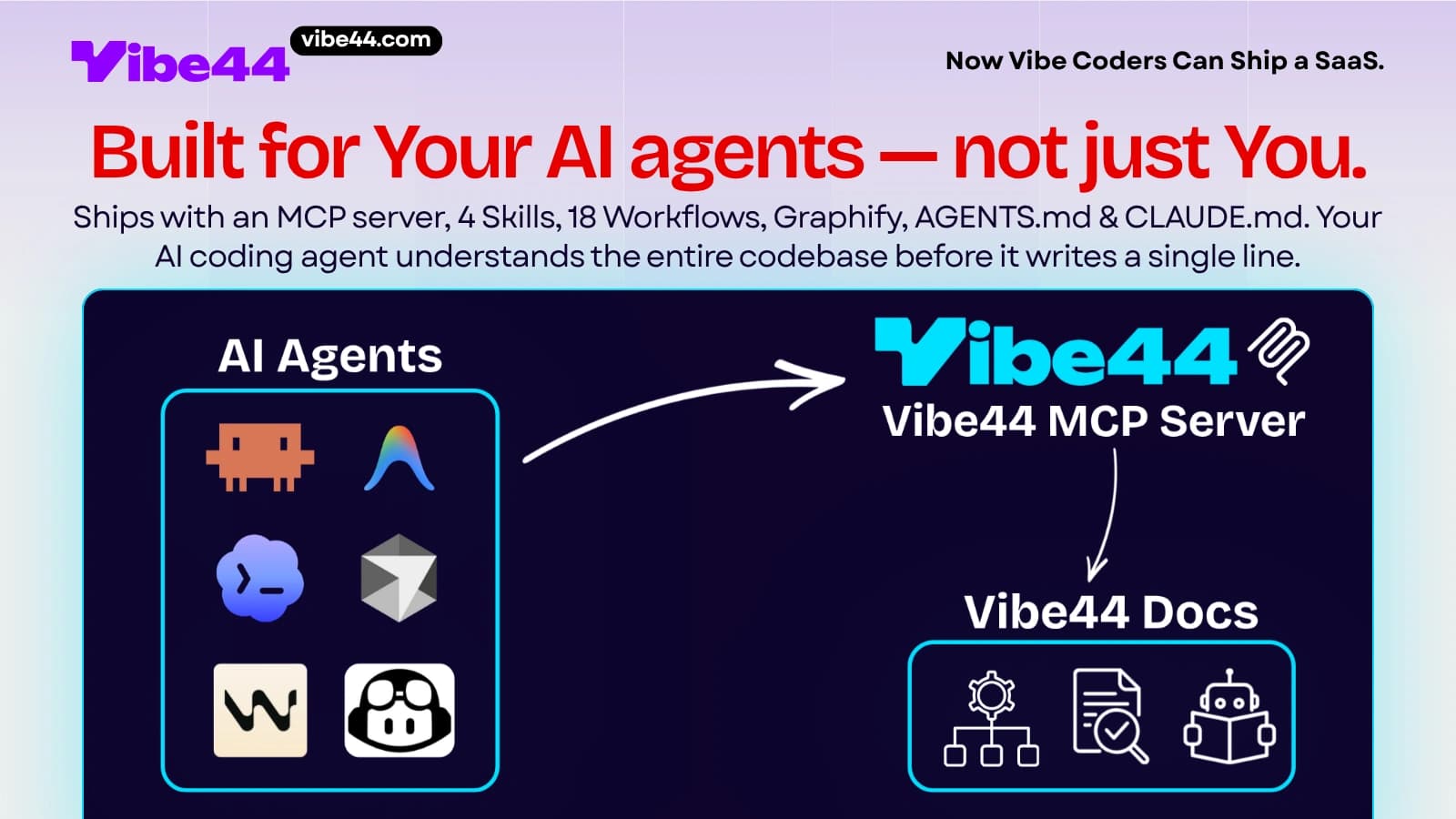
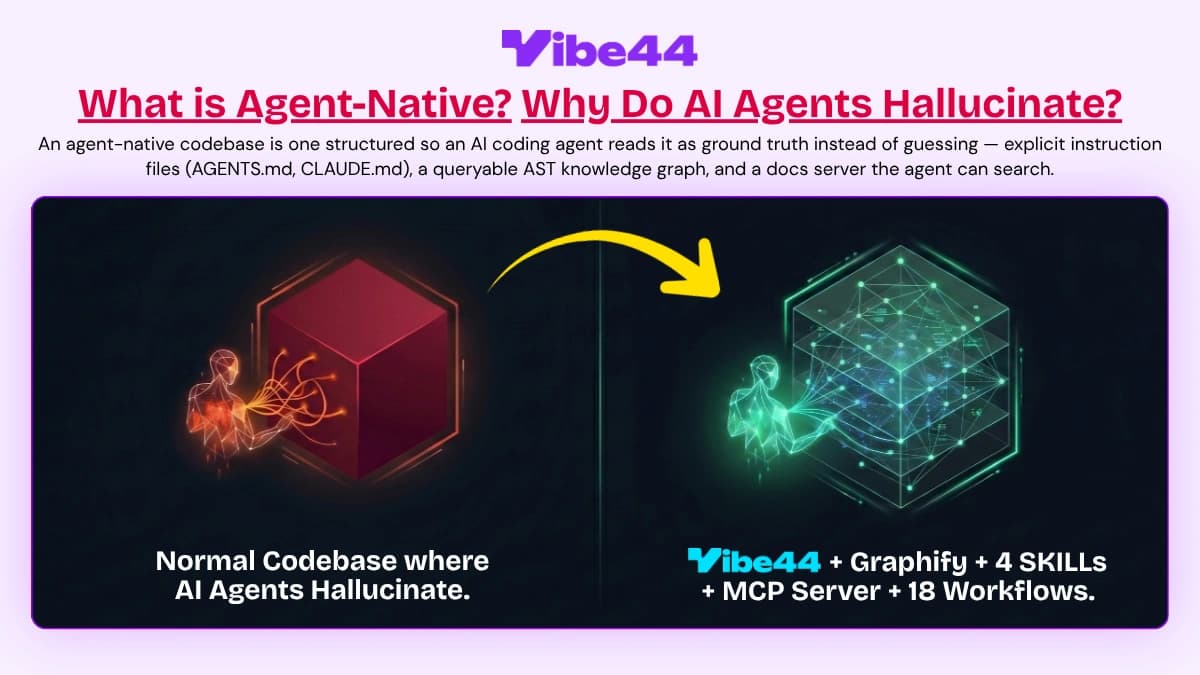
TLDR: An agent-native codebase is one structured so an AI coding agent
reads it as ground truth instead of guessing — explicit instruction files
(AGENTS.md, CLAUDE.md), a queryable AST knowledge graph, and a docs server
the agent can search. Vibe44 ships all three: the Graphify Context Engine
delivers up to 71.5x token cost reduction and measurably lower
hallucination by letting agents query structure rather than dumping whole
files into context. Human-readable code is table stakes; agent-readable code
is what stops your agent breaking auth.
Your agent writes a feature in 30 seconds and breaks auth in 3. The problem was never the model. It's that your repo is a black box the agent has to guess its way through. In 2026, AI agents can increase the volume of code written by 180%, but the amount of code actually shipped to production has only grown by ~30%. Why? Because only 29% of developers fully trust AI-generated code without manual verification. The bottleneck shifted from writing code to reviewing it.
I've watched this happen on every "vibe coding" session that goes sideways. The model isn't dumb. It's blind. You handed a brilliant engineer a codebase with no map, no conventions written down, and a context window that fits maybe 2% of your repo — then acted surprised when it confidently wired up something that returns 200 OK while leaking the wrong tenant's data. The fix isn't a smarter model. It's a codebase the agent can actually read.
That's what "agent-native" means, and it's about to be the difference between an agent that 10x's you and one that quietly mortgages your weekend to a debugging session. Let's define it precisely, look at why agents hallucinate your architecture, and walk through how to make any repo readable by the machine that's now writing half your code.
What's the difference between human-readable and agent-readable code?
Here's the crisp definition, answer-first: an agent-native codebase is one that exposes its own structure, conventions, and intent in a form an AI coding agent can read directly as ground truth — instead of forcing the agent to infer them by guessing from scattered files it can only partially see.
Human-readable and agent-readable are not the same thing, and that distinction trips up nearly everyone. A codebase can be a joy for a human and a nightmare for an agent.
A human engineer joining your team reads code lazily and laterally. They open three files, recognize a familiar pattern, ask a teammate "wait, where does billing live?", scroll past the parts that don't matter, and build a mental model over days. They carry that model in their head across weeks. They infer intent from a variable name, a folder structure, a half-remembered Slack thread. Humans are extraordinary at filling gaps with context they accumulate over time.
An AI agent has none of that. It has no persistent memory of your repo between sessions. It can't ask a teammate. It can only see what fits in its context window right now — and your repo does not fit. So when it needs to know how your auth core works, it has three options: read the relevant files (if it can find them and they fit), guess from patterns in its training data, or hallucinate something plausible. In a black-box repo, it's doing a lot of the last two.
Agent-readable means you've closed that gap deliberately. The conventions aren't implied by folder names — they're written down where the agent looks first. The architecture isn't something the agent reconstructs file by file — it's a graph the agent can query. The docs aren't a website the agent scraped six months ago — they're a live source it reads on demand. You've stopped making the agent guess.
Concretely, an agent-native repo answers four questions without the agent having to read your entire codebase to find out:
| The agent needs to know... | Black-box repo | Agent-native repo |
|---|---|---|
| How do I work in this codebase? | Infers from scattered files | Reads explicit instruction files (AGENTS.md, CLAUDE.md) |
| What's the architecture and what depends on what? | Re-reads files every prompt, guesses | Queries an AST knowledge graph |
| What's the official, current behavior of this library? | Recalls stale training data | Searches a live docs server |
| What are the boundaries I must not cross? | Discovers by breaking them | Told up front, in prose, durably |
If your repo can't answer those four cleanly, your agent is guessing — and guessing is exactly where production breaks.
Why do AI agents hallucinate your architecture?
Agents don't hallucinate because they're careless. They hallucinate because you've structurally forced them to. Three root causes, and every one of them is about missing ground truth.
There's no ground truth to reason from. When an agent needs to modify your billing flow, it needs to know how billing actually works in your repo — not how billing works in the average open-source project it trained on. If that knowledge isn't explicitly available, the agent does what any reasoning system does with incomplete information: it interpolates. It writes the statistically most likely billing code, which is a blend of ten thousand other repos. Sometimes that's close enough. Sometimes it bypasses the plan-gating check you wrote three files away, because the agent never saw that file and the "average" pattern doesn't include it. The agent isn't wrong about billing in general. It's wrong about yours, because yours was never on the table.
The context is stale or partial. Even agents that can read your files read a fraction of them. A real SaaS repo is hundreds of thousands of tokens. A context window — generous as they've gotten — still can't hold all of it alongside your prompt, the conversation history, and the files the agent's already pulled in. So the agent makes triage decisions: which files matter for this task? Get that triage wrong and it's reasoning from the wrong half of your codebase. Worse, agents re-read the same files across turns because they have no durable structural index — burning tokens to rebuild context they had ten minutes ago, then running out of room and dropping the file that actually mattered. Partial context doesn't announce itself. The agent doesn't say "I'm only 8% informed about this change." It just writes confident code on a foundation of fog.
Token limits force lossy compression. This is the quiet killer. Dumping whole files into context is enormously expensive and badly inefficient — you pay for every token of a 600-line file to extract the one function signature the agent needed. To stay inside budget, the agent (or your tooling) summarizes, truncates, and drops. Every one of those is a lossy operation, and lossy compression of code is how subtle bugs are born. A truncated function looks complete. A summarized module reads plausible. The agent reasons over the compressed version and produces output that's internally consistent and externally wrong. And the scariest bugs here are the ones that quietly return 200 OK — no stack trace, no crash, just a feature that works in the demo and leaks in production.
Stack these up and the failure mode is predictable: an agent that is fast, confident, fluent — and operating on a guess about your architecture that nobody verified. It writes the feature in 30 seconds because writing plausible code is easy. It breaks auth in 3 because auth was in the 92% of your repo it never actually read.
The fix is not to make the agent guess better. You can't prompt your way out of missing information. The fix is to give it ground truth.
How does Graphify's AST knowledge graph give agents ground truth?
This is the part of Vibe44 that changes how agents reason about the codebase, so let me be exact about the mechanism rather than hand-wave at "AI magic."
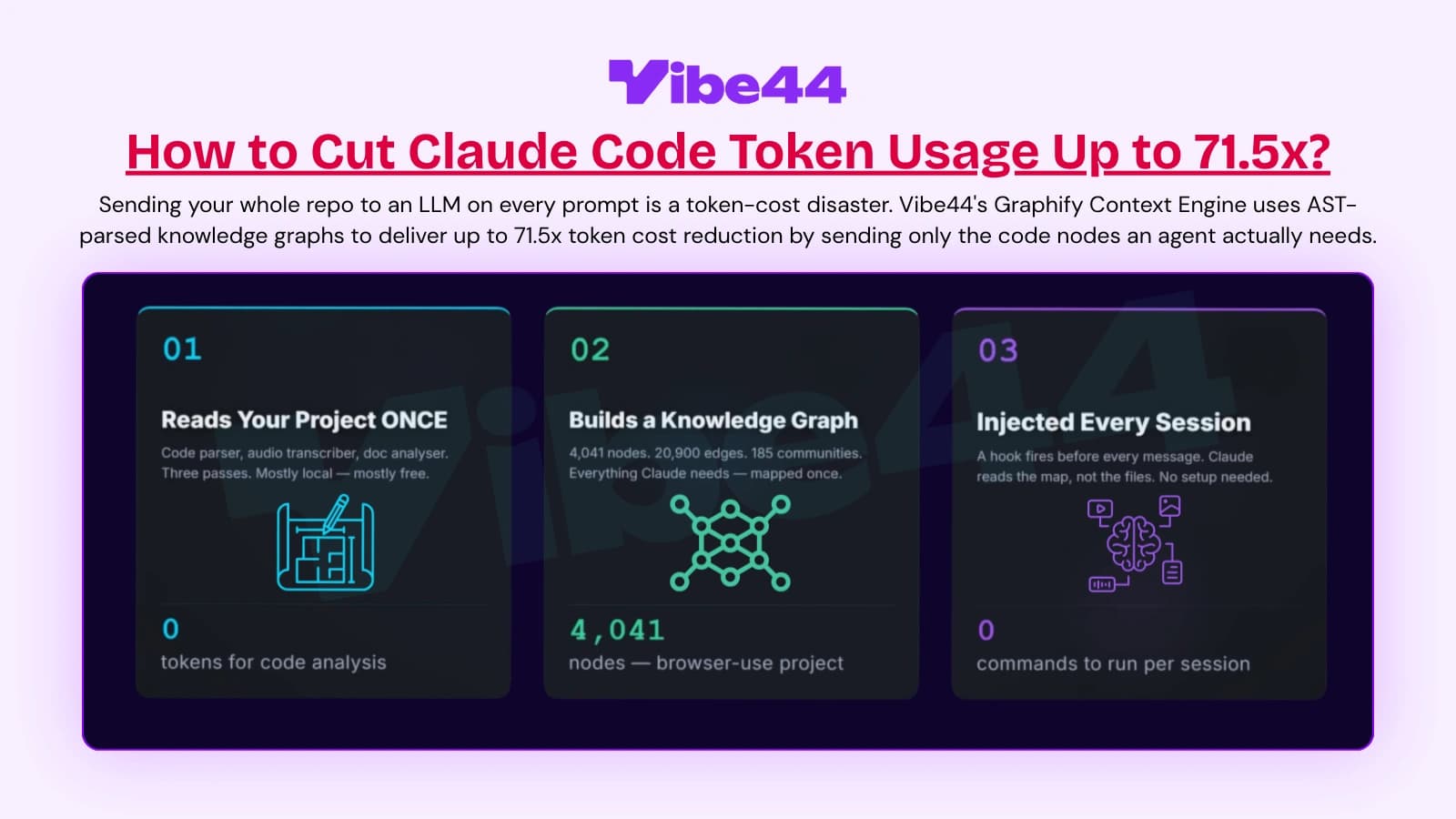
The Graphify Context Engine — it is a standalone CLI tool that writes its output to graphify-out/ — parses your entire codebase into an AST-based knowledge graph. Abstract syntax trees are how compilers actually understand code: not as text, but as structured trees of functions, types, imports, calls, and the relationships between them. Graphify walks those trees across your whole repo and builds a graph where every function, type, route, and module is a node, and every dependency, call, and import is an edge. The result in graphify-out/ is a precise, machine-queryable map of what your code is and what depends on what.
Here's why that matters for grounding. Without it, when an agent asks "what calls this function, and what would I break if I changed it?", the only way to answer is to read files — lots of them — and hope it found every caller. With the graph, the agent queries the relationship directly: every caller, every dependency, every type that flows through, returned as structured facts instead of guessed from a partial file scan. The agent reasons from your actual architecture, not from the statistical average of every repo it trained on. That's ground truth, made queryable.
And this is exactly where the up to 71.5x token cost reduction comes from — it's not a marketing number, it's a direct consequence of the architecture. Dumping whole files into context to answer a structural question is staggeringly wasteful: you pay for thousands of tokens to extract one relationship. Querying the graph returns just the relevant nodes and edges — the precise slice the agent needs — at a tiny fraction of the token cost. Less to read, less to pay for, and critically, less noise for the model to misread. The savings are real money on your API bill, and they compound on every single prompt across a build.
But the cost reduction is honestly the secondary win. The headline is lower hallucination. When an agent reasons from a structured graph of what genuinely exists in your codebase, it has far less room to invent. It's not interpolating a plausible architecture — it's reading yours. It doesn't guess which function handles tenant scoping; it queries and finds out. The graph constrains the agent to reality, and a constrained agent breaks production far less often than a free-associating one. (We go deep on the token-cost mechanics in How to Cut AI Coding Token Costs Up to 71.5x With a Codebase Knowledge Graph if you want the full breakdown.)
Ground truth is the whole game. Graphify is how Vibe44 hands it to the agent on every prompt.
How do AGENTS.md, CLAUDE.md, and the public MCP server work together?
Graphify answers "what is the structure?" But an agent needs two more things to be genuinely grounded: "how do I work in this codebase?" and "what's the current, official behavior of what I'm building on?" Vibe44 answers those with two instruction files and a docs server — and the three sources of truth reinforce each other.
AGENTS.md and CLAUDE.md are the agent's standing instructions. These are the files an agent reads first, before it touches a line of your code. AGENTS.md is the emerging open convention that most coding agents now look for; CLAUDE.md is the equivalent Claude Code reads by default. Vibe44 ships both, populated with the things you'd otherwise re-explain in every single prompt: the project's conventions, where things live, the architectural boundaries the agent must respect, how to run the tests, what not to touch. Without these, you're paying the "re-explain my codebase" tax on every conversation — and the agent's understanding resets to zero each session. With them, the agent starts every task already knowing the rules. It's the difference between onboarding a new engineer with a written runbook versus making them reverse-engineer your team's norms by breaking things.
The public docs MCP server is live, official ground truth for behavior. MCP — the Model Context Protocol — is the standard that lets an AI assistant call out to external tools and data sources. Vibe44 runs a public MCP server for its documentation: any AI assistant can connect to it, search the docs, and read individual pages back as clean markdown. That last detail is the point. Your agent isn't relying on a blog post it scraped last year or a doc page that was current three versions ago — it's reading the present official documentation, on demand, grounded in what Vibe44 actually does today. And because it's public, it's not just your agent that benefits; your users' agents can ground their answers about your stack the same way. (If you want to build one of these for your own product, we walk through it end to end in Give Your Docs an API for AI: Building a Public MCP Server for Documentation.)
Now watch how the three compose, because the multiplier is in the combination, not any single piece:
AGENTS.md/CLAUDE.mdtell the agent how to behave in this repo — the rules and conventions.- Graphify (
graphify-out/) tells the agent what exists and what depends on what — the structure. - The MCP server tells the agent how the platform officially behaves — the current truth.
Behavior, structure, and official truth. An agent grounded on all three isn't guessing about anything material. It knows the rules, it knows the architecture, and it knows the documented behavior — so the code it writes extends your foundation instead of fighting it. That's what agent-native looks like in practice, and it's why an agent on Vibe44 ships features that pass the 900 unit tests instead of features that quietly break them.
How do you make any repo agent-native? (A portable checklist)
You don't need Vibe44 to start applying this. The principles are portable, and you can retrofit a meaningful amount onto your own repo this week. Here's the give-away checklist — work down it in order of impact.
1. Write an AGENTS.md (and a CLAUDE.md). Start here because it's the highest return for the least effort. Put the things you re-explain to your agent constantly into a file the agent reads first: your conventions, your directory layout, how to run tests and lint, the boundaries it must not cross ("never modify the auth core without running the security suite"). Keep it current — a stale instruction file is worse than none, because the agent trusts it. This single file kills the per-prompt re-explanation tax overnight.
2. Make your architecture queryable, not just readable. This is the hard part and the biggest lever. Whether you build it, adopt a tool, or use something like Graphify, the goal is the same: give the agent a way to ask "what depends on this?" and "what calls that?" and get a structured answer instead of forcing it to read every file and hope. An AST-derived knowledge graph is the rigorous version. Even a maintained dependency map or a generated architecture index is a meaningful step up from a black box.
3. Stop dumping whole files into context. Audit how your agent gets its information. If your workflow pastes entire files (or worse, whole directories) into every prompt, you're paying the lossy-compression tax and inviting hallucination. Move toward retrieving the relevant slice — the specific function, the specific type, the specific relationship. Less context, more precisely chosen, beats more context, badly compressed. Your token bill and your bug count both go down.
4. Give your docs an API the agent can call. If your project or platform has documentation, make it machine-readable on demand — ideally via an MCP server that lets agents search and read pages as markdown. This stops agents from grounding answers in stale scraped data. It matters for internal docs your team's agents read, and it matters even more if you have users whose agents need to understand your product.
5. Write down intent, not just structure. Folder names tell an agent where things are. They don't tell it why. A short architecture note — "billing is provider-agnostic on purpose; route everything through the adapter, never call a provider SDK directly" — prevents a whole class of plausible-but-wrong changes. Agents respect boundaries they're told about and bulldoze the ones they have to infer.
6. Keep a real test suite the agent must pass. This is your safety net for everything above. Grounding reduces how often the agent drifts; tests catch it when it does anyway. An agent that can run your tests and see them fail will self-correct — it's the feedback loop that turns "wrote plausible code" into "wrote code that actually works." Vibe44 ships 900 Vitest unit tests and 9 Playwright E2E suites for exactly this reason, but any honest coverage on your critical paths beats none.
Work down that list and your repo stops being a black box. The agent stops guessing. Production stops breaking in ways you can't reproduce. None of it requires a smarter model — all of it requires a more readable repo.
Retrofit, or start agent-native by design
You have two paths from here.
You can retrofit your existing repo. Write the instruction files, build or adopt a way to query your architecture, stand up a docs server, and wire the feedback loop. It's real work — weeks of it if your codebase is large and undocumented — but the checklist above is honest and the payoff is real. Do it, and your agent gets dramatically more useful.
Or you start on a base that's agent-native by design. Vibe44 ships AGENTS.md and CLAUDE.md populated, the Graphify Context Engine CLI writing its AST knowledge graph to graphify-out/ for up to 71.5x token cost reduction, a public docs MCP server your agent can query today, and 900 tests plus 9 E2E suites to catch drift — all on a Next.js 16+ / TypeScript 6 / Supabase / Drizzle / Tailwind v4 foundation, for a $197 one-time license. Solo founders and bootstrap teams build on it instead of from an empty repo their agent can't read.
Two things to do before you decide anything:
- See it running. The live demo is at demo.vibe44.com — click through a real multi-tenant SaaS before you spend a dollar.
- Point your agent at the public MCP server and ask it anything about the codebase. Watch it answer from ground truth instead of guessing. That's the whole thesis, demonstrated in about thirty seconds.
Stop making your agent guess — give it a codebase it can actually read.
Frequently asked questions
1. What is an agent-native codebase, in one sentence? It's a codebase structured so an AI coding agent reads its conventions, architecture, and intent directly as ground truth — through explicit instruction files, a queryable knowledge graph, and a live docs source — instead of guessing them from partial file scans. Human-readable code is necessary but not sufficient; agent-native means the machine can read it too.
2. Why does my AI agent keep breaking production even though it writes good code?
Because fluent code and correct code are different things when the agent is missing ground truth. Three causes: no explicit source of truth for how your repo works, stale or partial context (your repo doesn't fit in the context window), and lossy token-budget compression that drops the detail that mattered. The agent writes statistically-plausible code that's wrong about your specific architecture — and the worst failures return 200 OK with no stack trace.
3. How does an AST knowledge graph reduce token costs by up to 71.5x?
Dumping whole files into context to answer a structural question is hugely wasteful — you pay for thousands of tokens to extract one relationship. Vibe44's Graphify Context Engine parses your code into an AST-based graph (output in graphify-out/) that the agent queries for just the relevant nodes and edges. Returning the precise slice instead of whole files cuts token cost up to 71.5x and, by reducing noise, lowers hallucination at the same time.
4. What's the difference between AGENTS.md and CLAUDE.md?
AGENTS.md is the emerging open convention most coding agents look for; CLAUDE.md is the equivalent that Claude Code reads by default. Both hold the same kind of content — conventions, architecture boundaries, how to run tests, what not to touch — so the agent starts every task already knowing the rules instead of re-deriving them. Vibe44 ships both, populated.
5. Can I make my existing repo agent-native without rebuilding it?
Yes — partially, and it's worth doing. Start with an AGENTS.md, make your architecture queryable rather than only readable, stop pasting whole files into context, give your docs a machine-readable API, write down intent not just structure, and keep a test suite the agent must pass. It's weeks of retrofit work on a large codebase, versus starting on a foundation like Vibe44 that ships all of it by design.