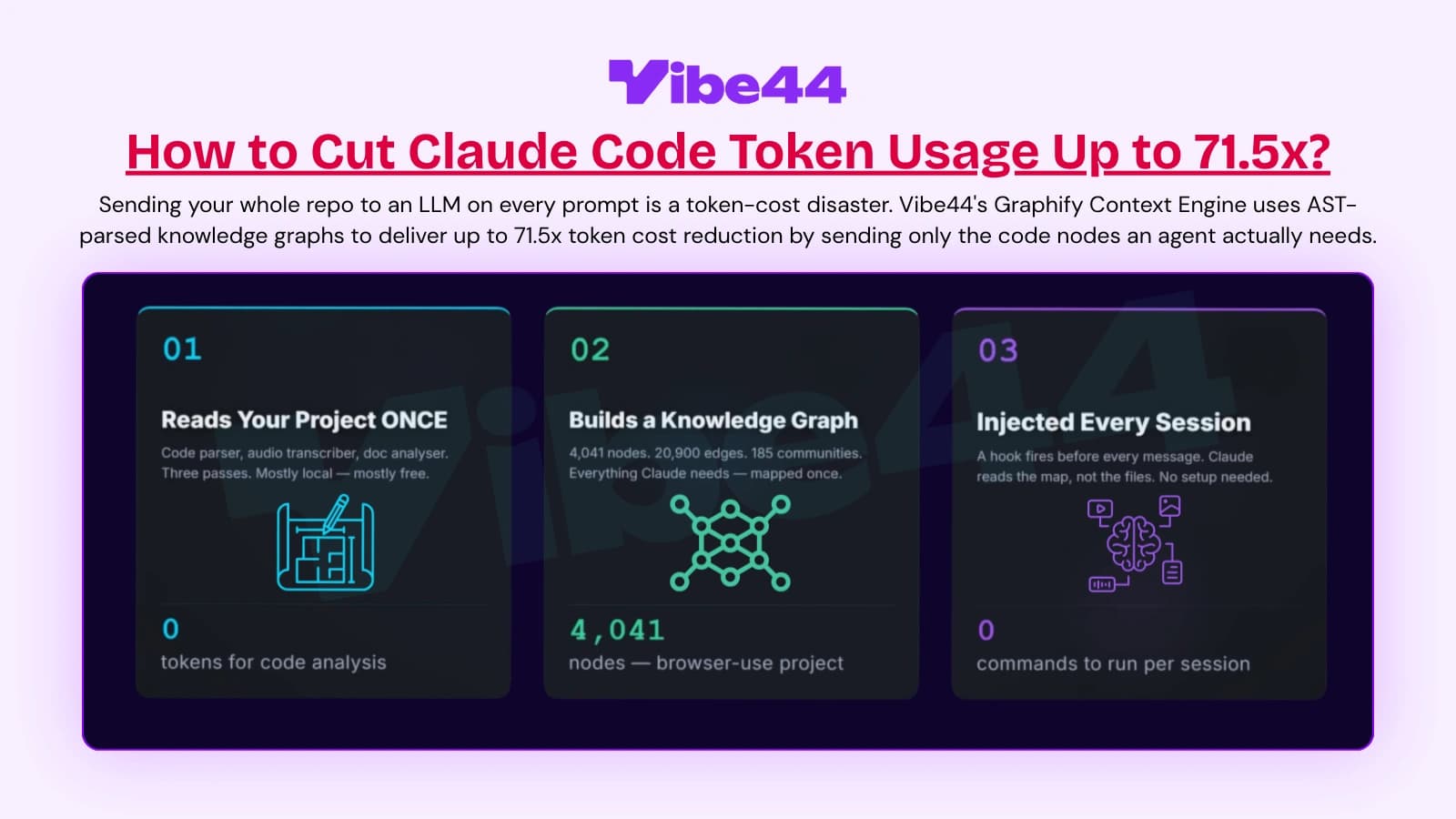
TLDR: Sending your whole repo to an LLM on every prompt is a token-cost disaster. Vibe44's Graphify Context Engine uses AST-parsed knowledge graphs to deliver up to 71.5x token cost reduction by sending only the code nodes an agent actually needs. top founders are already building on it for a $197 one-time license.
Dumping your whole repo into context on every prompt is exactly why your AI bill is brutal — and your agent still gets the answer wrong. You're paying to send thousands of lines of irrelevant code, and the model is hallucinating because signal is buried in noise. There's a structural fix, and it starts with understanding why naive context-stuffing fails at the architecture level.
Why does naive context-stuffing make AI coding so expensive and inaccurate?
Most teams hit the AI cost wall the same way. They give an agent access to the full codebase, fire off a prompt, and watch the token meter spin. It feels thorough. It isn't.
The problem is proportionality. A typical Next.js SaaS codebase has hundreds of files. In 2026, the AI coding tools market hit $10 billion, with 90% of professional developers using AI in their daily workflows. Whether you're using GitHub Copilot, Cursor (which hit $2B ARR), or Claude Code (the fastest-growing terminal agent), the constraint is the same: a meaningful feature request touches maybe 8-12 files. When you serialize the full repo and shove it into a prompt, you're paying for the other 90% of files that contribute nothing — and actively hurt the answer by diluting the relevant signal.
Hallucination rates go up with context noise, not down. A model reading 120,000 tokens of mostly-irrelevant code has more surface area for confused associations than one reading 3,000 tokens of precisely relevant code. More tokens, worse output, bigger bill. That's not a model failure — it's a context engineering failure.
Token costs compound fast. If you're spending $400/month on AI coding today and your context strategy is "give it everything," the inefficiency is structural. Switching models won't fix it. Prompt-tweaking won't fix it. You need a different retrieval architecture.
Why do knowledge graphs outperform vector RAG for code context?
Vector RAG became the default retrieval strategy because it generalizes. You chunk text, embed it, and retrieve semantically similar chunks at query time. For prose documents, this works well. For code, it has a critical blind spot: code isn't semantically chunked, it's structurally connected.
Consider what a function actually is. It has a name, parameters, a return type, and it calls other functions — which call other functions. If you chunk by line count, you'll split a function in the middle. If you chunk by file, you'll miss cross-file dependencies. Either way, the agent sees fragments. It doesn't see the dependency graph. It doesn't know that the function it's modifying calls a utility in lib/utils/ that's also used by three other routes.
Abstract Syntax Trees (ASTs) solve this. An AST parser doesn't read code as text — it reads it as structure. It knows that this node is a function declaration, those nodes are its imports, and that edge connects it to a class definition in another file. From an AST, you can build a knowledge graph where nodes are code entities (functions, classes, types, modules) and edges are real relationships (imports, calls, extends, implements).
When an agent queries a knowledge graph, it traverses real dependency paths instead of guessing from text similarity. The retrieval is deterministic, not probabilistic. You get the exact nodes that matter for the task at hand — nothing more.
Vector RAG for code is like searching a library by scanning every page for vaguely related words. A knowledge graph is like using the index, the card catalog, and the footnotes simultaneously.
Inside the Graphify Context Engine — how does Vibe44 deliver up to 71.5x token cost reduction?
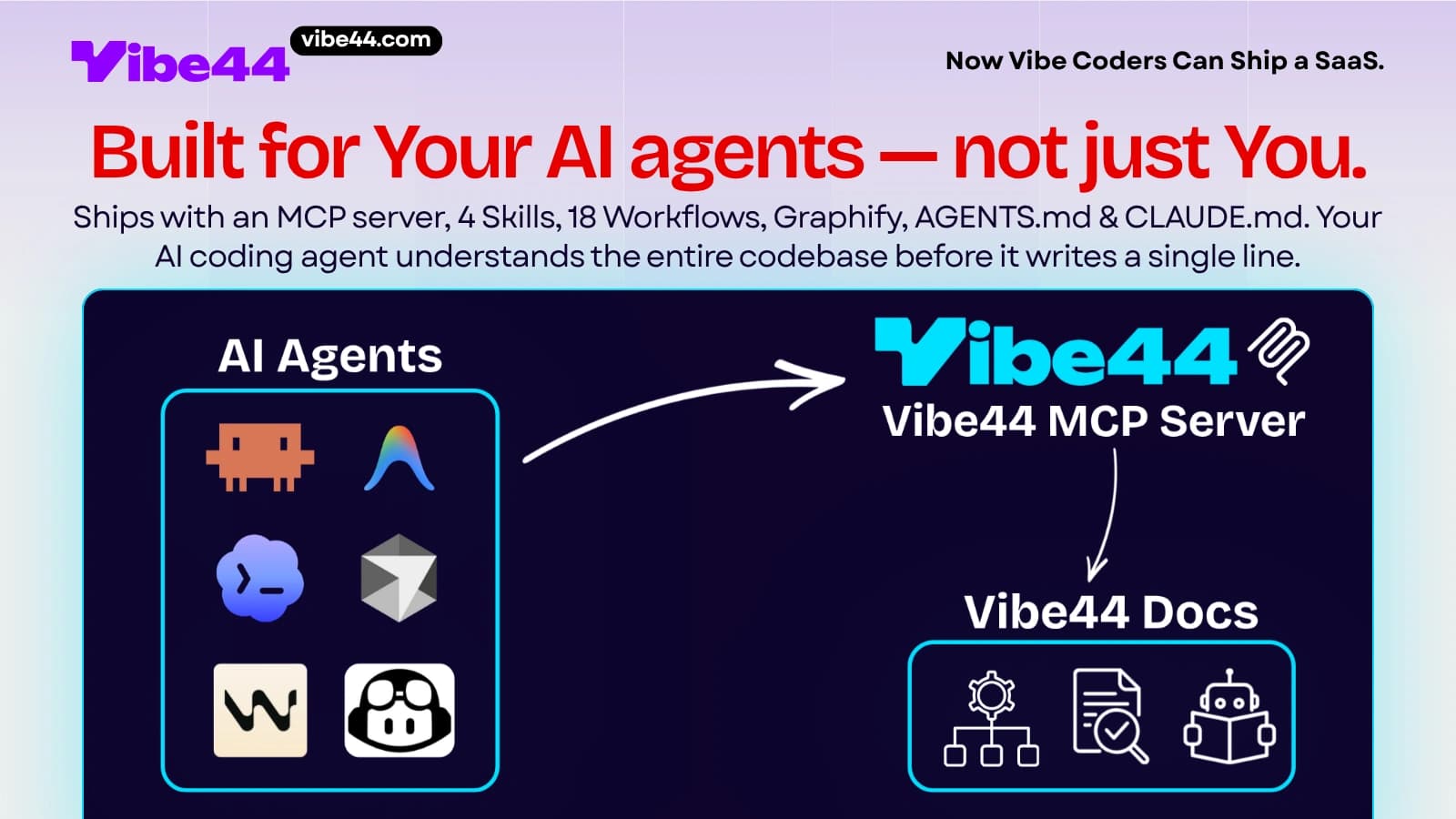
Vibe44 ships the Graphify Context Engine as a first-class part of the boilerplate, not a plugin or third-party add-on. It runs as a standalone CLI tool and outputs its artifacts to graphify-out/.
The engine runs an AST parse across your TypeScript codebase at build time. It maps every function, class, interface, type alias, and module export into a graph node. It records every import, function call, class extension, and type reference as a directed edge. The result is a complete structural map of your codebase serialized into graphify-out/ — a set of indexed files your agent can query without ever reading raw source.
When an agent needs context for a task, it queries the graph by entry point. Say the task involves modifying the authentication flow. The engine traverses from the relevant auth nodes, follows edges to direct dependencies, and stops at a configurable depth. The agent receives a compact, structured context bundle containing only the nodes in that subgraph. Files with no relationship to the auth flow are never loaded.
The 71.5x figure comes from that selectivity. A full-repo context dump for a mature codebase might run 80,000-100,000 tokens. A Graphify subgraph for the same targeted task might be 1,100-1,400 tokens. Same task. Fraction of the cost. Higher accuracy because the signal-to-noise ratio is orders of magnitude better. Fewer irrelevant tokens means fewer hallucinated connections between unrelated code paths.
The engine also reduces hallucination structurally. When an agent works from a dependency-accurate subgraph, it knows exactly what a function imports, what calls it, and what it returns. There's no room for it to invent a helper function that doesn't exist — because the graph would show no such edge.
This is why read What Is an Agent-Native Codebase? (And Why Your AI Agent Keeps Breaking Production) before wiring up any agent to your codebase. The Graphify engine is a core part of what makes a codebase agent-native — it gives agents structured access instead of raw file access.
What does the Graphify build-time workflow actually look like for an agent?
The workflow inverts the usual pattern. Instead of your agent reading files at query time, it reads a pre-built index. The heavy lifting happens once, at build time, not on every prompt.
You run the Graphify indexer, which parses your TypeScript source files and writes the graph artifacts to graphify-out/. This step is fast — typically under a minute for a large SaaS codebase. The output is a set of structured JSON files that represent the full node-and-edge graph of your code.
Your AGENTS.md file tells agents where to find the graph and how to query it. Instead of read_file("lib/auth/server.ts"), an agent makes a graph query: "give me the subgraph rooted at the session management module to depth 2." The engine resolves the query against graphify-out/ and returns the relevant nodes. The agent never touches raw source unless it explicitly needs to write a patch.
Re-indexing is incremental. When you add a new module or refactor a dependency, you re-run the indexer. Changed nodes update; unchanged nodes stay cached. You don't pay the full parse cost on every build.
The practical result: an agent working on a Vibe44 codebase makes fewer, cheaper, more accurate calls. It doesn't read 47 files to answer a question about 3. It queries the graph, gets the 3, and works. That discipline compounds across hundreds of agent invocations per day.
The same principle applies to your AI provider calls. For context on switching models without changing code, see One Codebase, Any LLM: A Provider-Agnostic AI Adapter (OpenAI, Anthropic, Gemini, DeepSeek) — the same adapter pattern applied to AI providers; if you're using both, understanding both abstractions shows how Vibe44 applies this principle across the stack.
How do you benchmark token savings before and after a knowledge graph?
You can't optimize what you don't measure. Here's a reproducible method to quantify your actual savings.
Start with a baseline measurement. Pick 10 representative agent tasks from your current workflow — feature requests, bug investigations, refactor scoping. For each task, record the exact tokens sent in the system prompt plus the user message before any optimization. Most LLM APIs return token counts in the response object; log them. Calculate the average tokens per task and your daily task volume. That gives you a monthly baseline.
Then run the same 10 tasks through a Graphify-powered context pipeline. Log the tokens sent for each. The delta is your actual compression ratio for your specific codebase and task distribution.
The 71.5x figure represents an upper bound observed on mature, well-modularized TypeScript codebases with deep dependency graphs — the kind of codebase where a single feature touches many files but a single Graphify subgraph captures it precisely. Your ratio will depend on codebase size, task specificity, and how deeply you've modularized your code. Codebases with tight, well-defined module boundaries see the highest compression. Monolithic files with everything in one place see lower — but still meaningful — gains.
For cost translation: take your current monthly AI coding spend, identify what fraction goes to context tokens (typically 60-80% of input tokens in a coding workflow), and apply your measured compression ratio to that fraction. A team spending $600/month on AI coding with 70% context overhead and a 30x compression ratio saves about $420/month. At 71.5x, the math is more aggressive.
Track accuracy alongside cost. Log the rate of agent retries, hallucinated imports, and broken function signatures before and after. Cost savings that come with accuracy improvements are compounding — fewer retries means fewer follow-up prompts means lower spend again.
Do the math on your own numbers: take your current monthly AI coding spend and divide by your measured compression ratio. That's your post-Graphify baseline. For most teams running naive context strategies, the number is jarring.
See the graph your agent reads — clone Vibe44 and run the indexer against your own codebase.
Frequently asked questions
1. What exactly is a 71.5x token cost reduction? It means a prompt that would have sent 71,500 tokens with naive context-stuffing sends 1,000 tokens through a Graphify subgraph query. The figure is an observed upper bound on mature, well-modularized TypeScript codebases. Your ratio scales with codebase modularity and task specificity — more modular code with targeted tasks produces higher compression.
2. Does the knowledge graph need to be rebuilt every time I change code?
No. The Graphify indexer runs incrementally. Only nodes connected to changed files are re-parsed and re-indexed. The unchanged majority of graphify-out/ stays cached. In practice, re-indexing after a typical commit takes seconds, not minutes.
3. How is this different from just using a .cursorrules or AGENTS.md file?
AGENTS.md tells an agent how to behave and where to find things. Graphify is the thing it finds — a queryable structural index of your codebase. They work together: AGENTS.md instructs the agent to query graphify-out/ instead of reading raw files, and the graph delivers precise context. One is instructions; the other is infrastructure.
4. Does Graphify work with any LLM, or just specific providers?
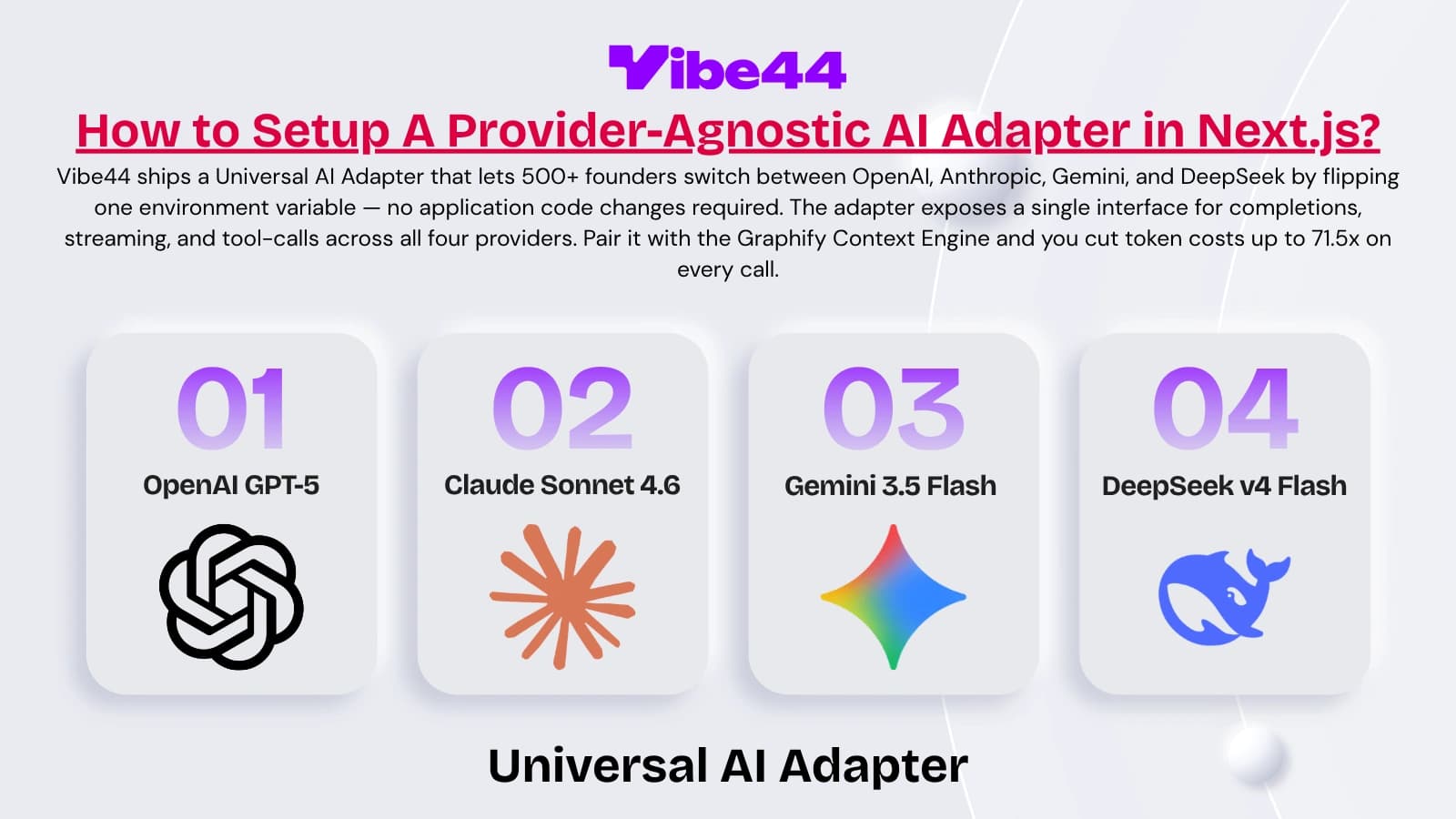
The graph output in graphify-out/ is plain structured JSON. Any LLM can consume it. Vibe44's Universal AI Adapter handles OpenAI, Anthropic, Gemini, and DeepSeek via a single env-var switch, so the token savings apply regardless of which model you're currently paying.
5. What does Vibe44 cost compared to building this infrastructure yourself? The DIY estimate for a full Vibe44-equivalent foundation — including the Graphify engine, security hardening, payment integration, and auth — is approximately 480 hours and $36,000 in developer time. Vibe44 is a $197 one-time license. The token cost savings on AI coding alone tend to recoup that within the first few months for any team running active agent workflows.