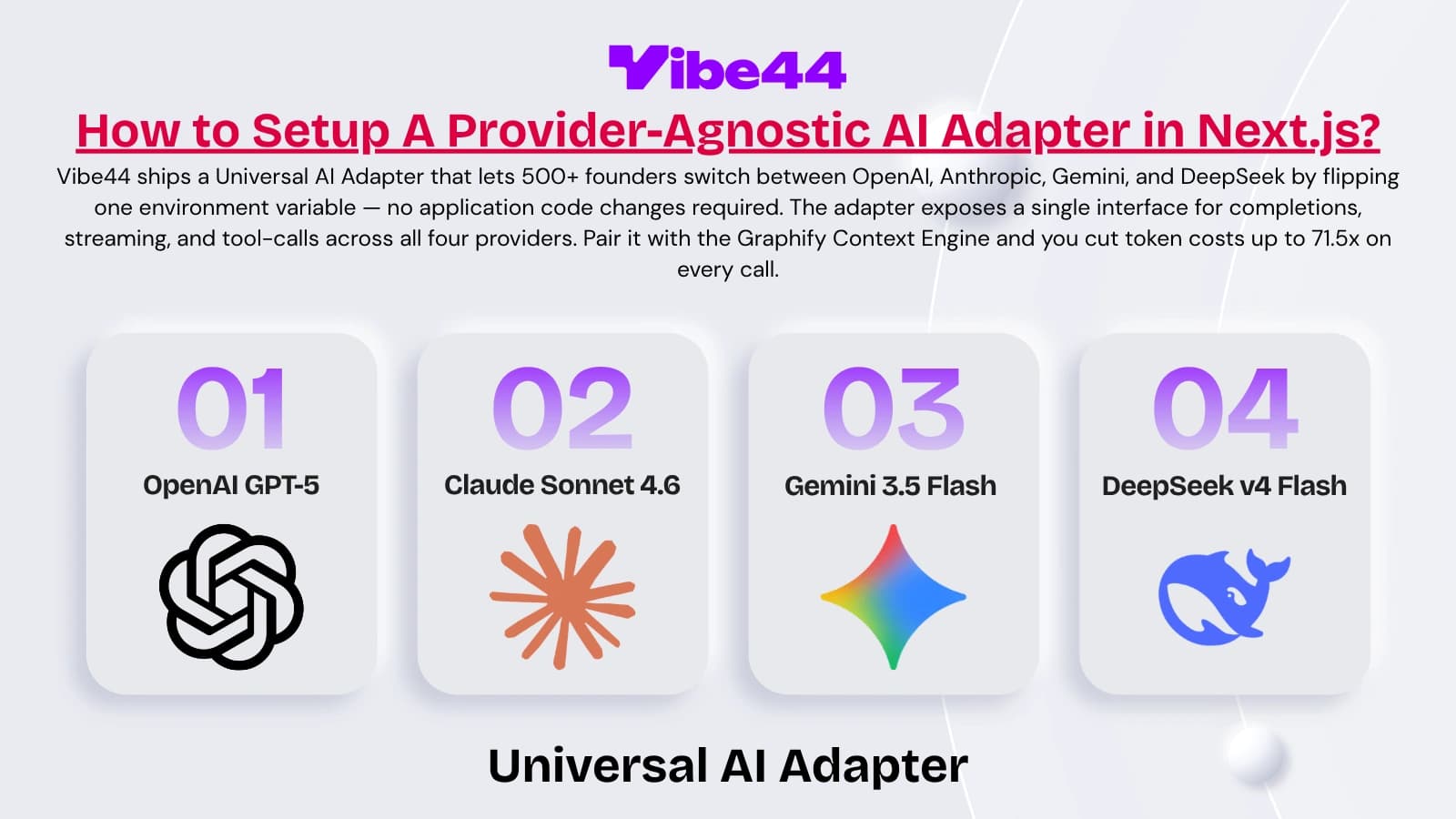
TLDR: Vibe44 ships a Universal AI Adapter that lets top founders switch between OpenAI, Anthropic, Gemini, and DeepSeek by flipping one environment variable — no application code changes required. The adapter exposes a single interface for completions, streaming, and tool-calls across all four providers. Pair it with the Graphify Context Engine and you cut token costs up to 71.5x on every call.
A new SOTA model drops every other week. With the AI coding tools market hitting $10 billion in 2026, and players like GitHub Copilot (20M+ users) and Cursor ($2B ARR) dominating workflows, the ecosystem is moving faster than ever. If swapping models means touching your whole app, you'll either fall behind or get locked into one vendor's price hikes. That's not a technical problem — it's an architectural decision you made (or didn't make) on day one. The teams that move fast aren't smarter; they built abstraction layers before they needed them.
This post walks through what a real provider-agnostic AI adapter looks like in a production Next.js codebase, what it needs to cover, and how Vibe44 implements it so you never rewrite your AI integration again.
Why model-agnostic architecture is a moat?
Vendor lock-in with AI providers is subtle until it isn't. You wire up OpenAI's SDK directly into five different API routes. You use their specific response shape, their specific streaming protocol, their specific tool-call format. Everything works great — until Anthropic ships a model that's 40% cheaper on your workload, or OpenAI changes pricing mid-quarter, or your enterprise customer requires on-premise Gemini deployment.
At that point, "switching providers" isn't a one-line change. It's a week of refactoring across every route that touches AI, followed by regression testing, followed by hoping you caught everything.
Model-agnostic architecture flips that dynamic. When your application code talks to an abstraction layer instead of a specific SDK, the provider becomes a configuration detail. You can arbitrage pricing, adopt new models the day they drop, and negotiate with vendors from a position of genuine leverage — because the switching cost is near zero.
This is optionality as a moat. Your competitors who went direct are trapped. You're not.
The compounding effect matters too. If you build provider-agnostic from the start, every feature you add — streaming responses, function/tool-calls, multi-turn context — gets built once and works everywhere. That's the difference between an architecture that scales and one that accumulates debt.
Abstracting completions, streaming, and tool-calls — the cross-provider interface
The hard part of AI abstraction isn't completions. A simple text-in, text-out wrapper is trivial. The hard part is making streaming and tool-calls work consistently across providers that implement them differently.
Completions are straightforward: normalize the input message format, call the provider, extract the text from whatever shape they return. Each SDK has its quirks, but a thin adapter handles them cleanly.
Streaming is where providers diverge. OpenAI uses server-sent events with a specific delta format. Anthropic's streaming protocol differs in chunk structure and event naming. Gemini has its own async iteration pattern. Your application code shouldn't know or care about any of this. The adapter's job is to expose a single async iterator or ReadableStream that your routes can consume identically regardless of which provider is live.
Tool-calls are the hardest. OpenAI calls them function calls with a specific JSON schema format. Anthropic uses a different tool-use structure. Gemini has its own function declaration format. When a model decides to invoke a tool, the response shape — including the call ID, the argument parsing, and the follow-up message format — differs across all three. An adapter that truly abstracts tool-calls has to normalize both the outbound tool schema and the inbound tool response so your tool handler logic is written once.
That three-layer abstraction — completions, streaming, tool-calls — is what separates a real provider interface from a wrapper that only handles the easy case.
The Vibe44 Universal AI Adapter — switch Gemini, OpenAI, Anthropic, or DeepSeek via env var
Vibe44 ships this abstraction out of the box. The lib/ai/ directory contains the full adapter system. Each provider gets its own implementation file — lib/ai/providers/openai.ts, lib/ai/providers/anthropic.ts, lib/ai/providers/gemini.ts, and lib/ai/providers/deepseek.ts — that translates provider-specific SDK calls into the shared internal interface.
The active provider is controlled by a single environment variable — AI_PROVIDER. Set it to openai, anthropic, gemini, or deepseek and the adapter factory resolves to the correct implementation at startup. Your API routes, your streaming handlers, your tool-call logic — none of them reference a specific provider. They call the shared interface and get consistent behavior regardless of what's underneath.
The consistent API covers all three layers: standard completions return a normalized message object, streaming returns a unified async iterator your frontend can consume with the same reader logic, and tool-calls use a shared schema format that each adapter translates to the provider's native format before the request goes out — and translates back on the way in.
This isn't theoretical. Vibe44 is running under 900 unit tests and 9 E2E suites. The adapter implementations are tested against each provider's actual response shapes, including streaming chunks and tool-call payloads. When you switch AI_PROVIDER, you're switching a tested, validated path — not hoping your abstraction holds.
The result for you: when Anthropic drops Claude 4 or OpenAI changes GPT-5 pricing, your migration is one environment variable and a redeployment. That's it. No code review, no regression sprint, no risk.
A deeper walkthrough of what makes a codebase genuinely agent-ready is in What Is an Agent-Native Codebase? (And Why Your AI Agent Keeps Breaking Production).
Pairing the AI adapter with Graphify — grounded, cheaper calls by default
Swapping providers saves money on unit cost. Graphify cuts the volume of tokens you're sending in the first place.
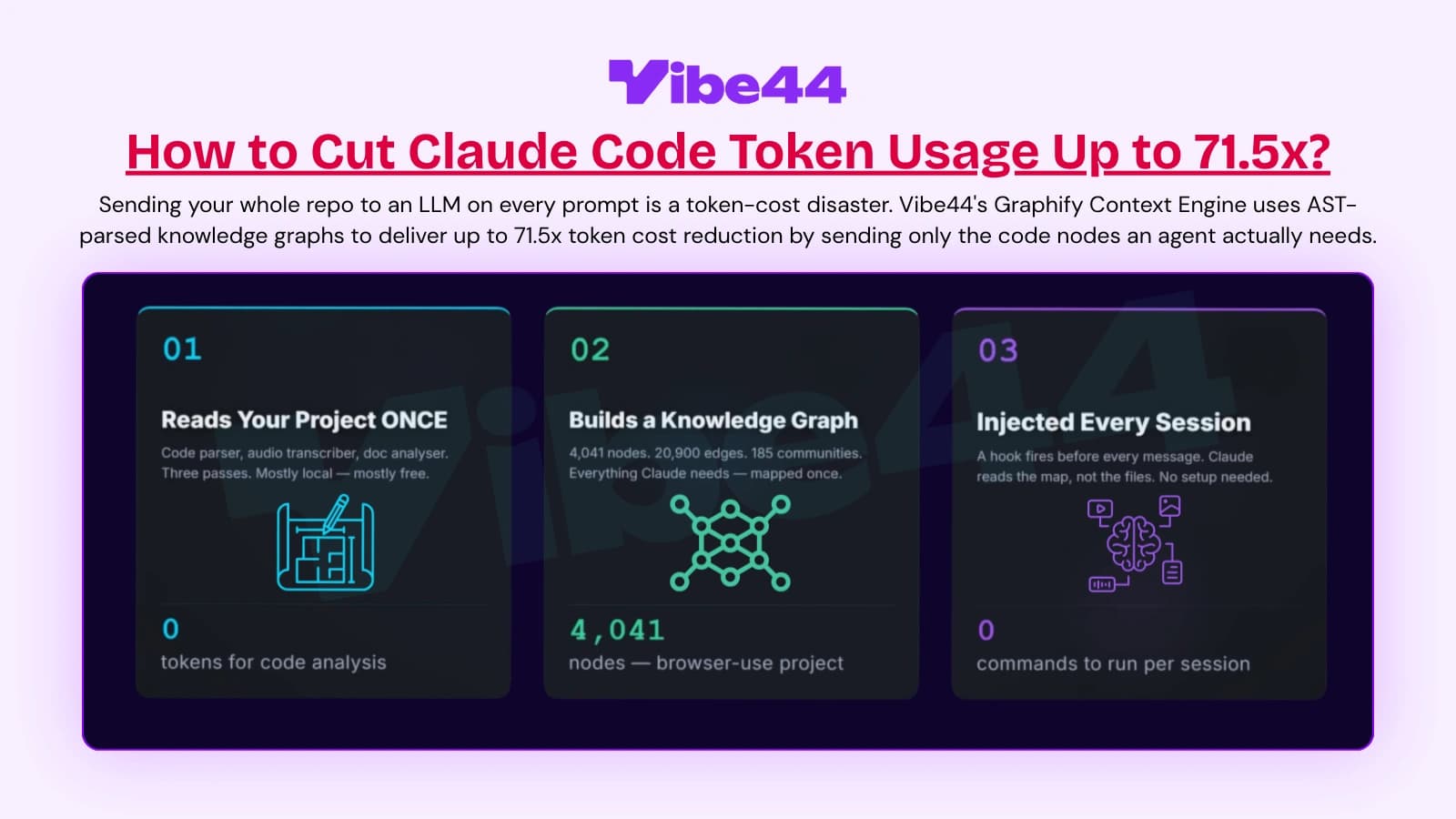
Graphify is Vibe44's Context Engine. It builds an AST-based knowledge graph of your codebase — every file, every function, every type relationship — and uses that graph to supply only the context actually relevant to each AI call. Instead of dumping your entire codebase into a prompt, Graphify resolves what the model needs to know and sends that. The result is up to a 71.5x reduction in token costs on codebase-aware calls.
The combination is multiplicative. The Universal AI Adapter lets you route to whichever provider has the best price-to-capability ratio for your use case. Graphify ensures the calls you make are as small as they can be without losing grounding. Together, they give you cost control on two axes simultaneously: what you pay per token and how many tokens you spend.
This matters especially for agentic workflows where an AI agent is making multiple calls per user action. Each call through the adapter gets Graphify's context injection automatically — the two systems are wired together in Vibe44's lib/ai/ layer. You don't configure the integration; it's on by default.
The full mechanics of Graphify and the token reduction approach are covered in How to Cut AI Coding Token Costs Up to 71.5x With a Codebase Knowledge Graph.
Handling provider quirks — rate limits, tokenization differences, and capability gaps
Abstraction doesn't mean pretending providers are identical. They're not, and a production adapter has to be honest about that.
Rate limits differ significantly. OpenAI, Anthropic, Gemini, and DeepSeek each have their own tier structures, requests-per-minute limits, and token-per-minute ceilings. The adapter layer is the right place to handle retry logic and backoff — centralized, consistent, not scattered across your application routes.
| Provider | Rate limit behavior | Tool-call support | Native streaming |
|---|---|---|---|
| OpenAI | Per-model RPM/TPM tiers | Full (parallel calls) | Yes (SSE) |
| Anthropic | Per-model, stricter on high-volume | Full | Yes (SSE) |
| Gemini | Quota-based per project | Full | Yes (async) |
| DeepSeek | Concurrency-based limits | Full | Yes (SSE) |
Tokenization is invisible to most developers until it causes a problem. Each provider uses a different tokenizer, which means the same input text has a different token count depending on where you send it. If you're enforcing context window limits in your application, you need to tokenize against the active provider's model — not a generic estimate. Vibe44's adapter exposes a countTokens method that routes to the correct tokenizer based on AI_PROVIDER, so your context budget calculations stay accurate across providers.
Capability gaps are real and worth naming. Not every model from every provider supports every feature at the same quality level. Vision input, extended context windows, and system prompt behavior vary. The adapter doesn't paper over these differences — it exposes capability flags so your application can make informed decisions about what to request from which provider. That's more useful than pretending they're interchangeable at every dimension.
The honest tradeoff: a shared interface adds a thin layer of indirection. In practice, the overhead is negligible and the operational flexibility is substantial. The quirks handling above is what makes the abstraction trustworthy rather than fragile.
The math on future-proofing
A full provider migration on a codebase with direct SDK calls costs days of engineering time, a full regression cycle, and non-trivial deployment risk. Conservative estimate: two to four engineer-days per migration, at whatever your time is worth.
With a provider-agnostic adapter, a migration is one environment variable change. That's a two-minute deploy. At current model release velocity — multiple significant releases per quarter — you'll want to move providers more than once a year. The abstraction pays for itself on the first switch.
Vibe44's $197 one-time license includes the Universal AI Adapter, Graphify, the full Next.js 16+ / TypeScript 6 / Supabase / Drizzle stack, and 32-table RLS with OWASP Top 10 (2025)-aligned security built in. top founders are already shipping on it.
See the adapter live at demo.vibe44.com — flip the provider and watch the same app call a different model with zero code changes.
Frequently asked questions
1. What does "switch LLM provider via env var" actually mean in practice?
You set AI_PROVIDER to openai, anthropic, gemini, or deepseek in your environment configuration. On the next application start, the adapter factory resolves to the matching implementation in lib/ai/providers/. Your application code — routes, hooks, streaming handlers — never changes. The 900 unit tests covering the adapter ensure each provider path behaves consistently.
2. Does the single interface support streaming for all four providers?
Yes. Each adapter implementation — lib/ai/providers/openai.ts, lib/ai/providers/anthropic.ts, lib/ai/providers/gemini.ts, and lib/ai/providers/deepseek.ts — normalizes the provider's native streaming protocol into a unified async iterator. Your frontend reader logic is identical regardless of which provider is active.
3. How does Graphify integrate with the AI adapter?
Graphify's context injection is wired directly into the lib/ai/ layer. When a call goes through the Universal AI Adapter, Graphify resolves the relevant context from its AST knowledge graph and prepends it to the prompt automatically. You don't configure this separately — it's on by default and produces up to 71.5x token cost reduction on codebase-aware calls.
4. What happens if a provider goes down or hits rate limits?
Rate limit handling and retry logic live in the adapter layer, not in your application routes. Each adapter implements exponential backoff against its provider's specific limit headers. Because the active provider is a configuration value, you can also switch AI_PROVIDER in your environment and redeploy to a different provider in minutes if you need to route around an outage.
5. Is the $197 license a subscription? No. It's a one-time purchase. You get the full codebase — including the Universal AI Adapter, Graphify, and all 32 RLS-protected tables — with no recurring license fees.