TLDR: The data model you pick on day one decides whether multi-tenancy is
a weekend or a quarter. Shared-schema with row-level security scales to
thousands of tenants on one database; schema-per-tenant and DB-per-tenant
trade that simplicity for operational weight you pay forever. Vibe44 ships
shared-schema multi-tenancy by default — RLS across 32 tables,
orgs/roles/permissions built in, tenant context wired through middleware.ts
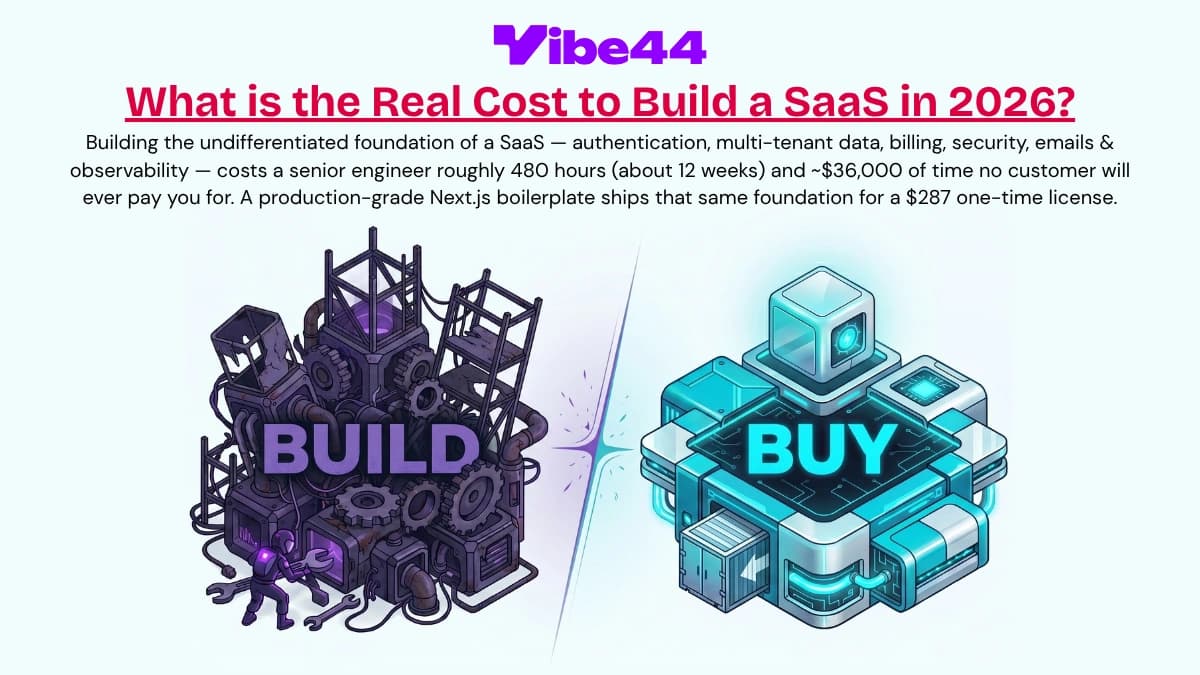
— for a $197 one-time license. For context, in 2026, a mid-complexity SaaS MVP
routinely costs $40,000–$150,000 to build, and the 480 hours ($36,000) it
takes to build the same foundation yourself is just the beginning.
Going single-tenant to multi-tenant is the refactor that eats your entire Q3. You start with one customer, one users table, and a WHERE user_id = $1 you trust. Then a team wants three seats. Then an enterprise wants their own admin. Now every query, every index, every cache key, and every background job needs a tenant boundary it was never designed for — and you're rewriting the foundation while customers are live on top of it.
Get the data model right on day one or pay for it forever. The good news: "right" is a known, bounded decision. There are three architectures, the tradeoffs are well understood, and for the vast majority of B2B SaaS the answer is the same. Let's make the decision once, correctly, so it never becomes a migration.
Which multi-tenancy model should you pick — shared-schema, schema-per-tenant, or DB-per-tenant?
Every multi-tenant system isolates tenants at one of three layers: the row, the schema, or the database. The layer you choose dictates your operational cost, your blast radius, and how hard onboarding a new tenant is for the rest of the app's life.
Shared-schema with row-level security puts every tenant's rows in the same tables, tagged with a tenant_id column, and lets the database enforce isolation through policies that filter every query automatically. One schema. One connection pool. One migration runs everywhere at once.
Schema-per-tenant gives each tenant their own set of tables inside one database — separate namespaces, identical structure. Isolation is stronger because tenants never share a table, but every schema migration now has to fan out across N schemas, and your connection and query routing has to know which schema to target on every request.
Database-per-tenant is the maximal-isolation option: each tenant gets a physically separate database. Compliance teams love it because a breach in one tenant cannot touch another's bytes. Operations teams pay for it daily — N databases to provision, migrate, back up, monitor, and connection-pool, and a control plane to route requests to the right one.
Here's the honest comparison:
| Dimension | Shared-schema + RLS | Schema-per-tenant | DB-per-tenant |
|---|---|---|---|
| Isolation strength | Logical (row-level, DB-enforced) | Strong (separate namespaces) | Maximal (physical separation) |
| New-tenant onboarding | Insert a row — instant | Provision a schema + migrate | Provision a database + migrate |
| Migrations | One run, all tenants | Fan out across N schemas | Fan out across N databases |
| Connection pooling | One pool, simple | Shared pool, schema switching | N pools or a proxy layer |
| Cost per tenant | Near zero | Low–moderate | High |
| Noisy-neighbor risk | Higher (shared resources) | Moderate | Lowest |
| Per-tenant data residency | Hard | Possible | Native |
| Blast radius of a bug | All tenants (if isolation fails) | Single schema | Single database |
| Best fit | Most B2B SaaS, thousands of tenants | Mid-market with per-tenant tuning | Regulated / enterprise residency |
The pattern is clear. Shared-schema scales horizontally to thousands of tenants on one database with the lowest operational tax — its single real weakness is that isolation depends on policies being complete and correct, because one missing policy exposes everyone. Schema-per-tenant buys you stronger isolation at the cost of migration fan-out. DB-per-tenant buys you compliance-grade separation and native data residency at the cost of running a fleet.
For most founders, shared-schema with RLS is the right default — not as a compromise, but because the failure mode (a missing policy) is testable and fixable, while the failure mode of the other two (operational sprawl) compounds with every tenant you add. You can start shared-schema and carve a single enterprise tenant onto their own database later if a contract demands it. You cannot easily start with a fleet and consolidate it down. The cheap-to-reverse decision is shared-schema first.
How do you wire tenant context, routing, and isolation without leaks?
Picking shared-schema is the easy half. The hard half is making sure every request knows which tenant it belongs to — and that the answer cannot be forged, dropped, or forgotten. Tenant isolation is a chain, and it leaks at whichever link is weakest.
Resolve the tenant at the edge. The request arrives carrying a tenant signal: a subdomain (acme.yourapp.com), a path segment (/t/acme/...), or a custom domain mapped to a tenant. Middleware running before your route handlers reads that signal, resolves it to a tenant identifier, and attaches it to the request context. In a Next.js app this is the job of middleware.ts — it runs on every matched request, sees the host and path before any page or API handler does, and is the correct place to establish "which tenant is this" exactly once.
Bind the tenant to the session, not the URL. The URL tells you which tenant is being requested; the session tells you which tenants the user is allowed to access. Those must agree. The session — issued at login and carried in a signed token — holds the user's identity and their tenant memberships. Middleware's real job is to reconcile the requested tenant against the session's allowed set and reject the mismatch. A user authenticated into Acme who flips the subdomain to a competitor's must get a hard no, not a query that happens to return empty. That reconciliation lives in the auth layer under lib/auth/, where session validation and tenant-claim extraction belong.
Scope every query — then enforce it below the query too. With the tenant resolved and trusted, your data access layer threads that tenant_id into every read and write. But application-layer scoping is a discipline, and disciplines slip: a new developer adds a reporting endpoint and forgets the filter, a cached result bleeds across tenants, a background job runs broad under a service account. So the database enforces the boundary independently. Row-level security policies, attached to each table, evaluate on every SELECT, INSERT, UPDATE, and DELETE and refuse rows whose tenant_id doesn't match the session's verified tenant claim — regardless of what the application code did or forgot. Two layers, each enforcing the constraint, neither trusting the other. That's the difference between isolation you assume and isolation you can prove. The mechanics of constructing that JWT-to-policy chain are covered end to end in Row-Level Security at Scale: Enforcing RLS Across 32 Supabase Tables.
Watch the cross-cutting leaks. Tenant boundaries fail in the unglamorous places: cache keys that omit the tenant (so tenant A warms a cache tenant B reads), full-text search indexes that aren't partitioned, file-storage paths that aren't namespaced, webhook handlers that trust a payload's tenant claim without verifying it, and analytics events written without a tenant tag. Audit every place data crosses a boundary — cache, queue, blob storage, search, logs — and confirm the tenant travels with it. The database protects your rows; it does not protect your Redis keys.
Done right, tenant context is established once at the edge, verified against the session, threaded through queries, and backstopped by the database. Four links, and the request is safe as long as none of them is missing.
How does Vibe44 deliver multi-tenancy by default — no bespoke wiring?
Most boilerplates hand you single-tenant scaffolding and a blog post on how to add tenancy. Vibe44 ships the boundary already built. Multi-tenancy is the default, not a tutorial — you opt out deliberately if you ever need to, and that decision is visible in the code rather than absent from it.
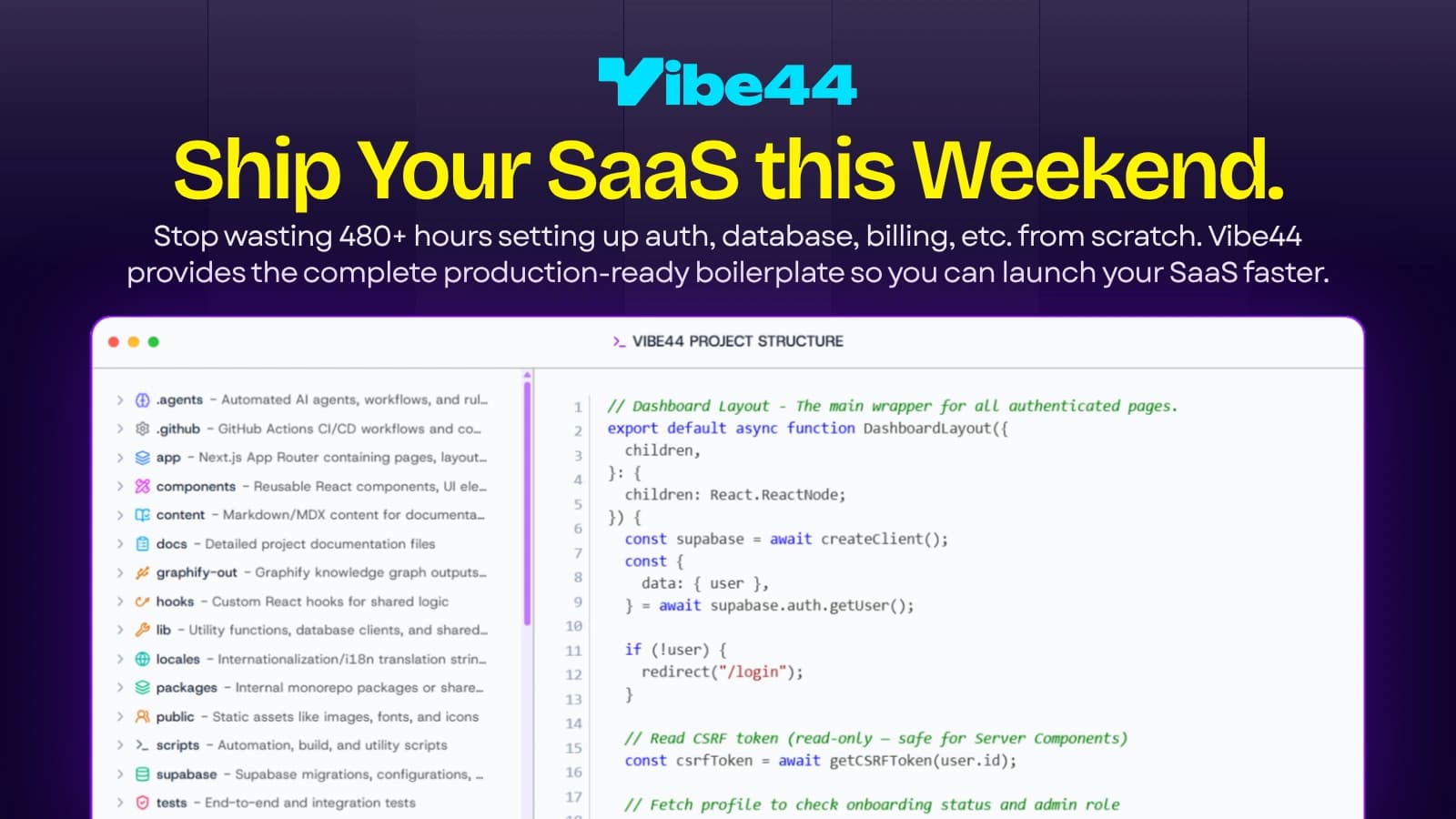
The data layer spans 32 tables — users, organizations, memberships, roles, subscriptions, billing, AI usage, audit logs, feature flags — and every table that holds tenant-scoped data carries a tenant_id and ships with RLS enabled and tenant-isolation policies already written. The schema definitions live in lib/db/schema/, expressed through Drizzle ORM over Supabase's PostgreSQL 15, so the table structure, the tenant column, and the foreign-key relationships are typed and version-controlled. The corresponding ENABLE ROW LEVEL SECURITY statements and CREATE POLICY blocks live in the migration history, which doubles as the audit trail: you can read exactly which policy exists on which table and when it was added.
The runtime chain is wired, not sketched. Tenant resolution and session reconciliation run through middleware.ts and the auth core under lib/auth/ — sessions, MFA, and PKCE are part of that core, and the session carries the tenant claim that the database extracts in its policy checks via a single helper function referenced everywhere instead of re-parsed per route. So the four links from the previous section — edge resolution, session verification, query scoping, database enforcement — arrive connected. You're not assembling them from parts. You're inheriting them assembled and tested.
Coverage across all 32 tables is the point. A partial multi-tenant setup — 28 tables isolated, 4 missed — is worse than no setup, because it hands you false confidence. A bug doesn't need many tables to leak a tenant; it needs one. Vibe44's starting line is complete coverage, backed by 900 Vitest unit tests and 9 Playwright E2E suites, a portion of which exercise the isolation layer directly — asserting that cross-tenant reads return empty, that writes with a mismatched tenant_id are rejected, and that a migration which drops a policy fails the build before it ships. You harden from a secure baseline instead of patching holes you discover in production. You can see the whole thing live at demo.vibe44.com.
What does Vibe44 give you for orgs, roles, and permissions out of the box?
Tenant isolation answers which data a request can touch. Access control answers what a member can do with the data they're allowed to touch. Those are different problems, and the second one quietly eats weeks if you build it from scratch — because real B2B customers don't arrive as a single user. They arrive as an organization with an owner who invites teammates, assigns roles, and expects an admin to remove a departing employee's access in one click.
Vibe44 ships that org model built in. Organizations are first-class tenants. Users hold memberships in organizations, and a single user can belong to more than one — the same human can be an owner of their own org and a member of a client's, with the active organization resolved per request through the same middleware-and-session chain that establishes tenant context. Roles and permissions come defined out of the box, so an owner, an admin, and a member have distinct capabilities from day one, and permission checks gate the actions that should be gated — inviting members, changing billing, deleting data, accessing the admin surface.
This is the layer founders consistently underestimate. The org/roles/permissions system, the invitation flow, the membership lifecycle, and the permission checks woven through the app are roughly the access-model work that takes weeks to build and get right — and it's load-bearing the moment your first team customer signs up. Building it badly means re-architecting permissions after launch, which is its own Q3-eating refactor. Vibe44 gives you the model already wired into the tenant boundary, the auth core, and the 32-table schema, so authorization and isolation reinforce each other instead of being two systems you have to keep in sync by hand. The access-control surface is part of why the broader build-vs-buy math in Next.js SaaS Boilerplate: Build vs. Buy — The Real 2026 Cost Math lands where it does: this is real senior-engineering time, and you only pay it once.
What breaks at scale — connection pooling, noisy neighbors, and data residency?
Shared-schema multi-tenancy scales beautifully right up until it doesn't, and the failure points are predictable. Knowing them in advance is the difference between a tuning task and a fire drill.
Connection pooling is the first wall. PostgreSQL connections are expensive, and a multi-tenant app with serverless functions can open far more than the database can hold — every cold-started function wants its own connection, and you exhaust the limit long before you exhaust the CPU. The fix is a pooler in front of the database: Supabase ships connection pooling (PgBouncer-style) for exactly this, multiplexing many client connections onto a small set of real ones. The discipline is to point your serverless and edge traffic at the pooled endpoint, reserve direct connections for migrations and long-lived jobs, and keep transactions short so connections return to the pool fast. Shared-schema makes this easy — one pool serves all tenants — which is precisely the operational advantage you lose with DB-per-tenant's N pools.
Noisy neighbors are the cost of sharing. When tenants share a database, one tenant's runaway query, bulk import, or report-generation job can starve everyone else's latency. Shared-schema has the highest exposure to this of the three models. You manage it rather than eliminate it: index your tenant_id columns so per-tenant queries stay fast, set statement timeouts so a single query can't run unbounded, rate-limit expensive operations per tenant, and watch per-tenant query cost so you can see a heavy tenant before customers do. If one tenant genuinely outgrows the shared pattern — a whale with 10x everyone else's load — the escape hatch is to migrate that single tenant onto isolated resources, which is far cheaper than having started everyone on isolated resources.
Data residency is the constraint that can force the model. Some customers — and some jurisdictions — require that their data physically live in a specific region. Shared-schema, by design, puts everyone in one database in one region, so native per-tenant residency is its weakest dimension. If residency is a hard requirement for a segment of your market, that's the case where DB-per-tenant (or a per-region shard) earns its operational cost. The practical play for most founders: start shared-schema, serve the customers who don't require residency, and stand up a separate regional database for the enterprise tenant who contractually does — a bounded, one-tenant project rather than a fleet you provision speculatively. Let the contract that needs isolation pay for the isolation it needs.
The throughline: shared-schema's weaknesses are all manageable with known tools — a pooler, indexes, timeouts, per-tenant limits, and a documented escape hatch for the rare tenant that outgrows it. That's a far better position than the alternative models' weaknesses, which are structural and compound with growth.
A multi-tenant refactor is weeks of senior work plus the risk of leaking a tenant's data while you're rebuilding the foundation under live customers. Starting multi-tenant is a clone. That's the entire build-vs-buy decision in one sentence.
Building the multi-tenant foundation yourself — schema design, tenant scoping, RLS policies and their tests, the org/roles/permissions model, the session-to-policy chain — is part of the 480 hours ($36,000, roughly 12 weeks at $75/hour) it takes to assemble the undifferentiated base of a SaaS. None of it is the feature your customers pay for. Vibe44 ships that base done: shared-schema multi-tenancy across 32 tables, isolation enforced at the database and verified by 900 unit tests and 9 E2E suites, orgs and roles built in, for a $197 one-time license that top founders are already building on.
Clone the multi-tenant base, open lib/db/schema/, and build your product on a tenant boundary you didn't have to invent.
Frequently asked questions
1. What is the best multi-tenant architecture for a Next.js SaaS?
For most B2B SaaS, shared-schema with row-level security. It scales to thousands of tenants on a single database, onboards a new tenant by inserting a row, runs one migration across all tenants at once, and uses a single connection pool. Its only real weakness — that isolation depends on complete, correct policies — is testable and fixable, unlike the operational sprawl of schema-per-tenant and DB-per-tenant that compounds with every tenant you add. Vibe44 ships shared-schema with RLS across 32 tables by default.
2. Can I really ship a multi-tenant SaaS in a weekend?
You can ship the foundation in a weekend if you start from one that's already built — tenant resolution in middleware.ts, session-bound tenant claims in lib/auth/, scoped queries, and RLS across all tables. What takes a weekend is wiring your product features onto that boundary. What takes a quarter is building the boundary itself from scratch, which is the ~480-hour, ~$36,000 effort Vibe44 removes from your critical path.
3. When should I choose database-per-tenant instead of shared-schema?
When a customer or jurisdiction requires that data physically reside in a specific region, or when a single enterprise contract mandates physical separation for compliance. In those cases the per-tenant operational cost is justified for that segment. The practical approach is to start shared-schema and migrate the specific tenant that needs isolation onto its own database — a bounded one-tenant project — rather than provisioning a fleet of databases speculatively for customers who don't require it.
4. How does Vibe44 stop one tenant from reading another tenant's data?
Two independent layers. The application resolves and verifies the tenant at the edge through middleware.ts, reconciles it against the session's allowed tenants, and scopes every query by tenant_id. Below that, the database enforces row-level security policies across all 32 tables that reject any row whose tenant_id doesn't match the session's verified claim — regardless of what the application code did. Neither layer trusts the other, and a portion of the 900 unit tests and 9 E2E suites assert that cross-tenant access returns empty.
5. Does shared-schema multi-tenancy hit a scaling ceiling?
Its scaling limits are manageable with standard tools. Connection exhaustion is solved with a pooler — Supabase ships one. Noisy neighbors are managed with indexed tenant_id columns, statement timeouts, and per-tenant rate limits. Data residency, its weakest dimension, is handled by migrating the specific tenant that requires it onto a regional database. Each weakness has a known fix, which is why it's the right default for most B2B SaaS rather than a model you outgrow.