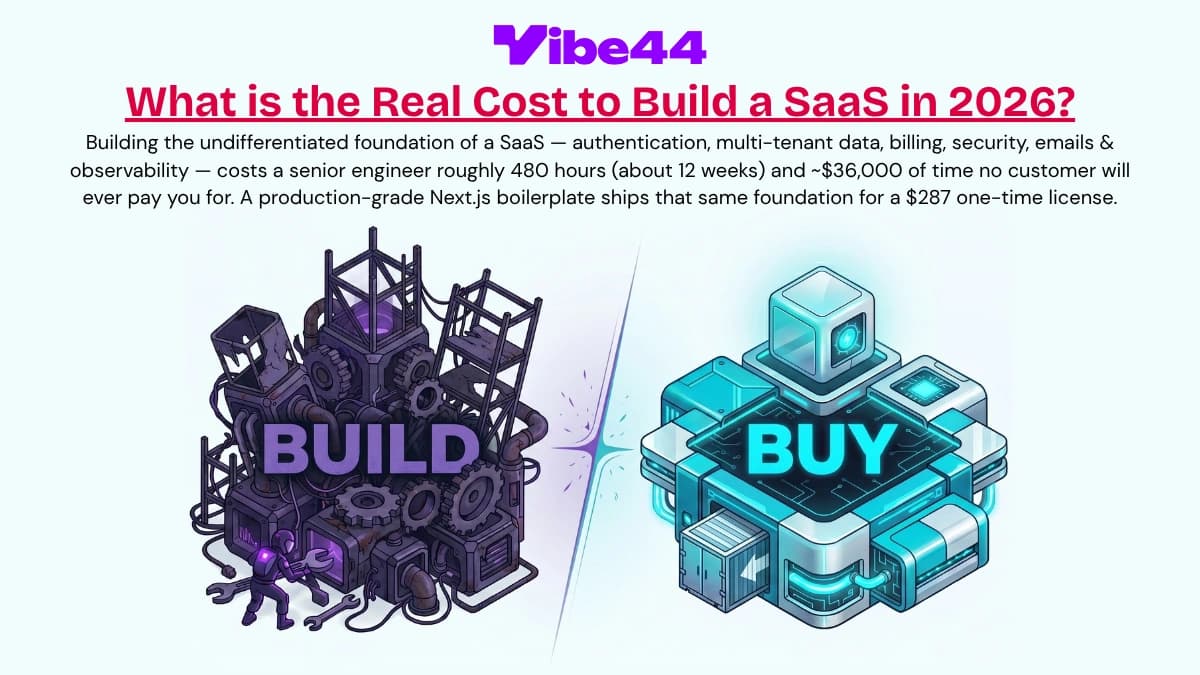
TLDR: Building the undifferentiated foundation of a SaaS — authentication, multi-tenant data, billing, security, and observability — costs a senior engineer roughly 480 hours (about 12 weeks) and ~$36,000 of time no customer will ever pay you for. A production-grade Next.js boilerplate ships that same foundation for a $197 one-time license: 32 tables protected by row-level security, Universal Payment and AI adapters you switch with one environment variable, and OWASP Top 10 (2025)-aligned hardening on day one. Buy when your moat is your product; build only when your stack is genuinely exotic.
You can build auth, billing, row-level security, and an admin panel yourself. I've done it more than once. It costs about 12 weeks and roughly $36,000 of senior engineering time — and here's the part that stings: not one customer will ever pay you a cent for any of it.
Nobody signs up for your product because you hand-rolled session rotation. They sign up for the one thing only you can build. Every hour you spend re-implementing password-reset flows and Stripe webhook idempotency is an hour stolen from the feature that actually wins you the deal.
This is the build-vs-buy decision every Next.js founder and agency faces in 2026, and most people get the math wrong because they only count the hours they can see. So let's count all of them — the visible ones, the hidden ones, and the ones that show up as a breach six months after launch.
What does it actually cost to build SaaS infrastructure yourself?
The honest number is about 480 hours of senior work. At a conservative blended rate of $75/hour (though top full-stack engineers command $80–$180+/hr) for a senior engineer in 2026, that's $36,000, spread across a focused 12-week build at 40 hours a week. I've shipped every line item below, so this isn't a hypothetical estimate — it's where the time actually goes.
| Foundation system | Hours | What's actually in it |
|---|---|---|
| Authentication | 80 | Sessions, OAuth + PKCE, MFA, email verification, password reset, rate-limited login |
| Multi-tenant data + RLS | 60 | Schema design, tenant scoping, row-level-security policies, policy tests |
| Billing & subscriptions | 80 | Provider integration, webhook idempotency, plan gating, proration, dunning, customer portal |
| Admin & user management | 50 | Dashboard, roles/permissions, impersonation, audit trails |
| Security hardening | 50 | CSRF, SSRF, security headers, input validation, secrets management |
| Transactional email | 25 | Templates, delivery, retries, unsubscribe handling |
| Observability & CI/CD | 40 | Error monitoring, structured logging, pipelines, preview deploys |
| Testing | 50 | Unit + end-to-end coverage on the critical paths |
| UI system, theming, i18n | 30 | Component library, dark mode, localization scaffolding |
| Glue, config, deploy, debugging | 15 | The "why is prod different from local" tax |
| Total | 480 | ≈ 12 weeks, ≈ $36,000 |
But $36,000 is the cheap part. The expensive part is the twelve weeks.
While you're debugging why your refresh token rotates twice on Safari, the competitor who bought their foundation shipped three features, talked to forty users, and closed their first ten customers. That's the cost nobody puts in the spreadsheet: opportunity cost. It isn't measured in dollars — it's measured in the runway you burned and the market position you didn't take while you were re-deriving solved problems.
And the $36k assumes you get it right the first time. You won't. Nobody does. The bugs in this layer aren't the kind that throw a satisfying stack trace — they're the kind that quietly return 200 OK while leaking one tenant's data to another. You don't find them in QA. You find them in a customer email that starts with "I think I can see someone else's account." Budget for the rework, because it's coming.
Then there's the cost everyone forgets: the foundation isn't build-once, it's maintained forever. Next.js ships major versions. Your auth library deprecates an API. A CVE drops in a dependency you haven't thought about in eight months and now you're patching on a Friday night. The 480 hours buys you version 1.0 — it does not buy you the steady tax of keeping that 1.0 secure and current while you're also trying to build your actual product. This is the line item that quietly makes DIY the gift that keeps on taking, and it's exactly what "lifetime updates" on the buy side is designed to absorb.
So the real DIY cost is: $36,000 + twelve weeks of opportunity cost + the rework you can't yet see + the maintenance tax that never stops. Hold that number. Now let's look at what "done" even means.
What does "production-ready" actually include?
This is where the DIY estimate quietly doubles. When founders say "I'll just build auth and billing," they're picturing the happy path: a login form and a checkout button. Production-ready is the unhappy paths — the 80% of the iceberg under the water. Here's the checklist most people underestimate.
Security that survives hostile users. Row-level security at the database, not just if (user.id === resource.ownerId) scattered through your route handlers. CSRF protection that actually binds to the session instead of trusting that a cookie came back. SSRF guards on every outbound fetch — your avatar-import or link-preview feature is one crafted URL away from reading your cloud metadata endpoint. Security headers, strict input validation, and secrets that live anywhere but your repo.
Billing that doesn't lose money. Webhook idempotency, because your payment provider will deliver the same event twice and you cannot grant the plan twice. Plan gating that can't be bypassed by editing a request payload. Dunning for failed renewals. Proration when someone upgrades mid-cycle. A self-serve customer portal so you're not processing cancellations by hand at 11pm.
Auth that doesn't leak. Session-fixation defense, token rotation, MFA, and OAuth with PKCE implemented correctly — the redirect and state handling is exactly where everyone gets subtly owned.
Observability so you find out before your users do. Error monitoring, structured logs, and a CI/CD pipeline that runs your tests before anything touches production.
Each of these is a known-hard problem with a known-correct answer. None of them is your product. (We break the full list down in our companion piece, The Production-Readiness Checklist: 27 Things Your Next.js SaaS Needs Before Launch.)
Here's why this matters for the cost math: the happy-path version of auth + billing might genuinely be 60 hours. The production-ready version is the 480. The gap between "works on my machine" and "survives real, paying, hostile users" isn't a detail — it's the entire job.
What do you get with Vibe44 on day one?
Here's the alternative, and the numbers are exact because precision is the whole point.
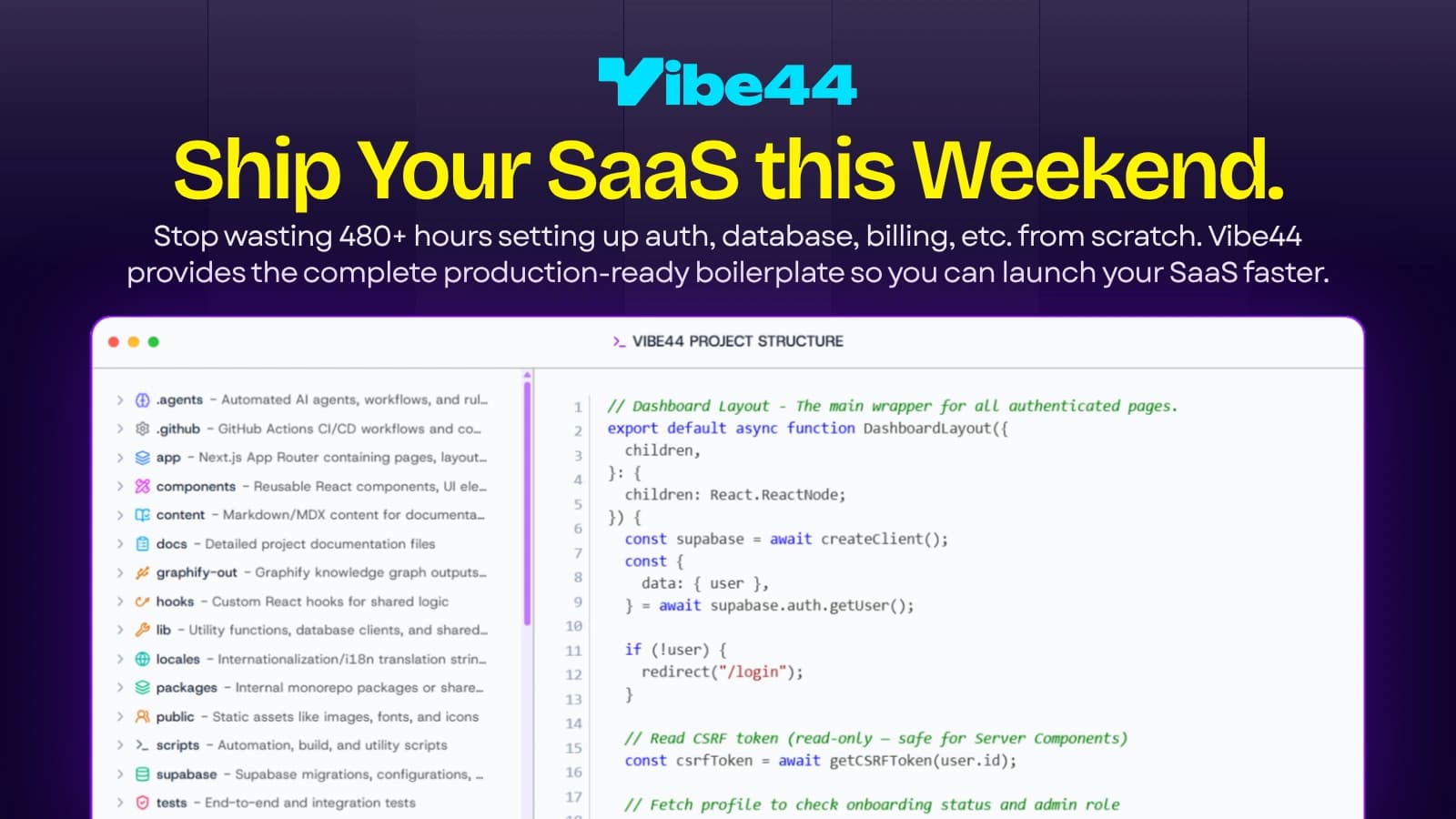
Vibe44 is a Next.js 16+ SaaS boilerplate built on TypeScript 6, Supabase (PostgreSQL 15), Drizzle ORM, and Tailwind v4. For a $197 one-time license — not a subscription, not per-seat forever — you git clone and, running locally in under five minutes, you have:
- 32 tables protected by row-level security, so tenant isolation is enforced at the database layer, not bolted on in application code where one forgotten check leaks data.
- A Universal Payment Adapter that switches between Stripe, Lemon Squeezy, Polar, Dodo, and Creem with a single environment variable — your checkout call sites never change.
- A Universal AI Adapter that switches between OpenAI, Anthropic, Gemini, and DeepSeek the same way, so a new SOTA model is an env flip, not a refactor.
- OWASP Top 10 (2025)-aligned security: HMAC-bound CSRF tokens, SSRF-hardened outbound requests, hardened headers, and a real auth core with sessions, MFA, and PKCE.
- 900 unit tests (Vitest) and 9 end-to-end suites (Playwright), so you can change things without praying.
- Observability, CI/CD via GitHub Actions, transactional email, i18n, and a shadcn/ui component system — already wired.
That's the 480-hour list: shipped, tested, and maintained. Put it side by side and the decision stops being interesting:
| Build it yourself | Vibe44 | |
|---|---|---|
| Time to foundation | ~12 weeks | < 5 minutes to clone |
| Cost | ~$36,000 in time | $197 one-time |
| RLS coverage | However far you get under deadline | 32 tables, by default |
| Payment providers | Whatever you hardcoded | Stripe / Lemon Squeezy / Polar / Dodo / Creem, env-var switch |
| AI providers | Whatever you hardcoded | OpenAI / Anthropic / Gemini / DeepSeek, env-var switch |
| Security baseline | Your best effort under deadline | OWASP Top 10 (2025)-aligned |
| Tests | The ones you had time for | 900 unit + 9 E2E |
| Ongoing updates | You, forever | Lifetime updates |
Solo founders have started here instead of from an empty create-next-app. The license costs less than a single day of the senior engineer you'd otherwise assign to rebuild all of this — and that engineer would still be on week one.
How does an agent-native base compress weeks into days?
Now the part that changes the equation entirely in 2026: you're not building alone. You're building with an AI coding agent. And here's what nobody tells you — an AI agent pointed at a black-box repo is a liability, not a multiplier.
Point Claude Code, Cursor, or an autonomous agent at a typical codebase and it does the only thing it can: it guesses. It re-reads files it already read, hallucinates your architecture, confidently writes a feature in 30 seconds, and breaks auth in three. The model was never the bottleneck. The bottleneck is that the repo gives the agent no ground truth to reason from.
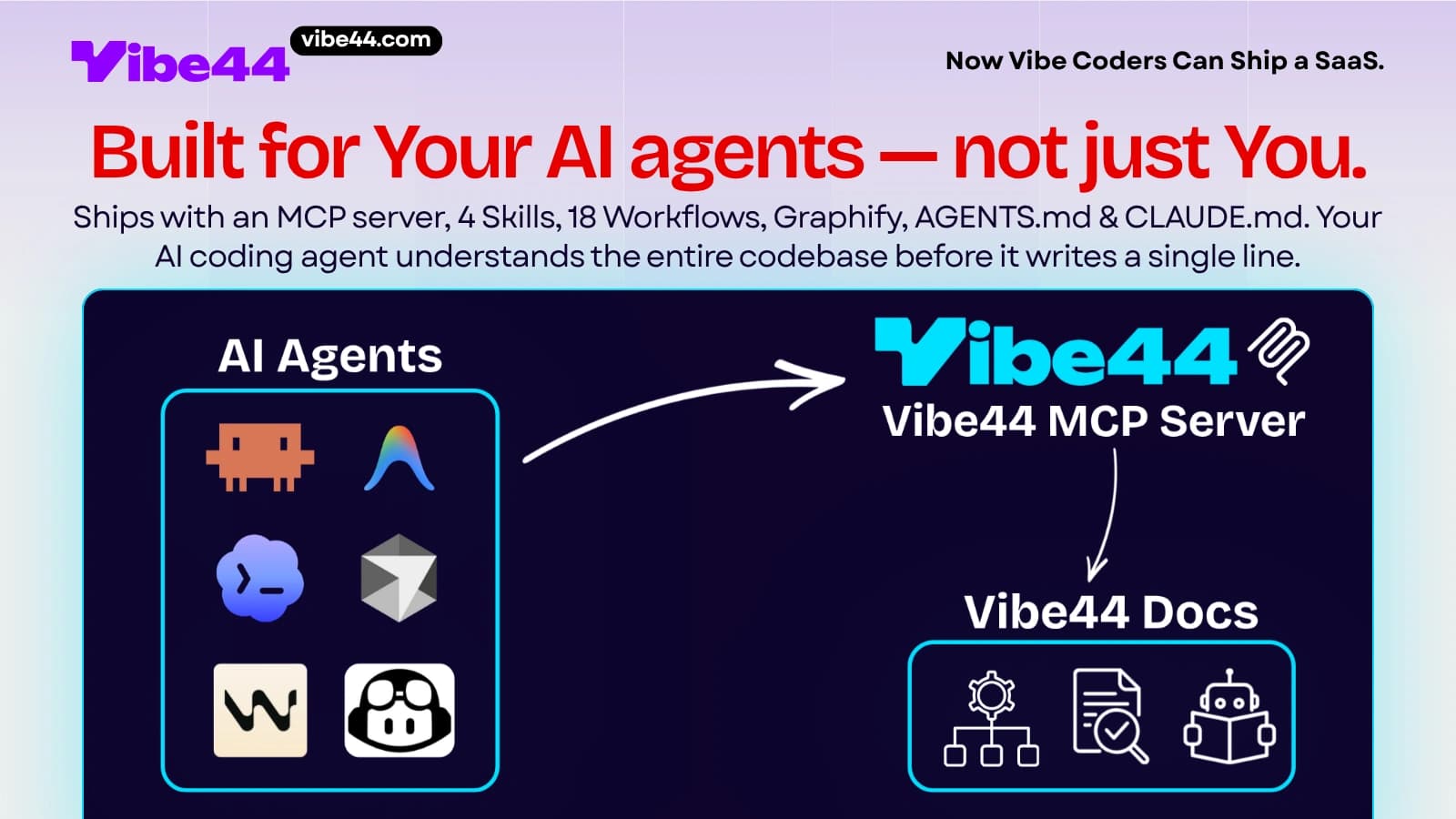
Vibe44 is built to be read by agents, not just humans. Three things make that real:
- The Graphify Context Engine parses your codebase into an AST-based knowledge graph that the agent queries instead of dumping whole files into context on every prompt. That's how it delivers up to 71.5x token cost reduction — and, because the agent reasons from structure instead of fuzzy guesses, it hallucinates far less.
AGENTS.mdandCLAUDE.mdgive the agent explicit, durable instructions about how this codebase works — its conventions, its boundaries, the things you'd otherwise re-explain in every single prompt.- A public docs MCP server lets your agent (and your users' agents) search Vibe44's documentation and read pages as markdown, grounding answers in the current official docs instead of a blog post scraped last year.
Put it together and the twelve-week build doesn't merely shrink to a $197 download — it becomes a weekend. The foundation is already there; your agent, properly grounded, extends it safely on top, with 900 tests catching it when it drifts. We walk through exactly that loop in From Idea to Paying Users in a Weekend: An AI-Agent-Driven Build Workflow, and unpack the underlying idea in What Is an Agent-Native Codebase?
This is the real multiplier: a production foundation plus an agent that can actually reason about it. Neither half gets you there alone. A grounded agent on an empty repo still has nothing to stand on; a brilliant foundation with a guessing agent still ships broken features. You need both, and that's the combination a build-from-scratch approach structurally can't give you in a weekend.
When should you NOT buy a boilerplate?
I promised honest disqualifiers, so here they are. Buying a boilerplate is the wrong call when:
- You're not building SaaS. A marketing site, a content blog, a single-purpose tool, an e-commerce storefront — none of these need multi-tenant auth and metered billing. A SaaS boilerplate is dead weight you'll spend time deleting.
- Your stack is genuinely exotic. If you're committed to a non-Next.js framework, a non-Postgres datastore, or an architecture the foundation doesn't assume (heavily event-sourced, offline-first, real-time-first), you'll fight the boilerplate more than it helps you.
- Infrastructure is your product. If you're building an auth provider, a billing platform, or a database, you obviously can't outsource the thing you sell. Build it, and build it better than anyone.
- You're deliberately learning. If the entire goal is to understand how RLS or OAuth works by implementing it yourself, buying the answer defeats the purpose — though reading a production-grade implementation is usually a faster teacher than a blank file.
Notice what's not on that list: "I can build it myself." Of course you can. So can I. Capability was never the question. The question is whether re-deriving solved infrastructure is the best use of the only non-renewable resource you have — your time before the runway runs out.
Build vs. buy: run your own numbers
Here's the calculator, deliberately simple:
Your build cost = (your senior hourly rate × 480 hours) + (12 weeks of opportunity cost — the features you won't ship and the customers you won't talk to) + (the rework you can't yet see).
Your buy cost = $197, one time.
Plug in your real rate. Even at a modest $50/hour, the build side is $24,000 before opportunity cost. At $100/hour it's $48,000. The decision makes itself.
Two friction-killers before you decide:
- See it running. The live demo is at demo.vibe44.com — click through the auth, the billing, and the dashboard before you spend a dollar.
- Clone it in five minutes.
git clone,pnpm dev, and you're looking at a running multi-tenant SaaS. Then point your AI coding agent at the public MCP server and ask it anything about the codebase.
Price out your own build above — then clone the answer.
Frequently asked questions
1. How much does it really cost to build a SaaS boilerplate from scratch? About 480 hours of senior engineering — roughly 12 weeks at 40 hours/week — which at a blended $75/hour is approximately $36,000. That covers a production-ready foundation (auth, multi-tenant RLS, billing, security, observability, tests), not just a login form and a checkout button. The happy-path version is far cheaper; the version that survives hostile users is where the hours actually go.
2. Is a one-time $197 license really cheaper than building it myself? Yes — by orders of magnitude. $197 one-time versus ~$36,000 in engineering time isn't a close comparison, and that's before counting the twelve weeks of opportunity cost. Unless infrastructure is literally your product, buying the foundation is the financially obvious move.
3. What do I actually get with Vibe44 on day one? A Next.js 16+ / TypeScript 6 / Supabase (PostgreSQL 15) / Drizzle / Tailwind v4 codebase with 32 RLS-protected tables, Universal Payment (Stripe/Lemon Squeezy/Polar/Dodo/Creem) and AI (OpenAI/Anthropic/Gemini/DeepSeek) adapters switchable by env var, OWASP Top 10 (2025)-aligned security including HMAC-bound CSRF, plus 900 unit tests and 9 Playwright E2E suites — all running locally in under five minutes.
4. Will I be locked into one payment provider or AI model? No — that's the entire point of the Universal Adapters. Change your payment or AI provider via a single environment variable and your call sites stay identical. You're never refactoring 40 files because you moved to a merchant-of-record for global VAT or switched to a newer model.
5. Does buying a boilerplate make my AI coding agent less useful?
The opposite — if the boilerplate is agent-native. Vibe44 ships a Graphify AST knowledge graph (up to 71.5x token cost reduction), AGENTS.md/CLAUDE.md, and a public docs MCP server so your agent works from ground truth instead of guessing. A grounded agent on a solid foundation is exactly what turns a twelve-week build into a weekend.